
7 October 2025 –
12 January 2026
Sandiganbayan RECEPTION Hall, National Museum of Fine Arts



2024 Thirteen Artist Awardees
by Mervy Pueblo
The 2024 Thirteen Artists Awardees reveal a Philippine art that is awake, attentive, and insistently present. Across media and methods—video, sculpture, tapestry, watercolor, installation—they dwell in the spaces where memory, care, nature, and material converge, reflecting a generation that listens to the world with curiosity, care, and imagination.
Memory, History, and Identity threads through several practices. Joshua Serafin’s Cosmological Gangbang enacts precolonial, gender-diverse mythologies, reclaiming bodies and histories that the empire sought to erase. Russ Ligtas’ The Last Hapi layers diaspora, ritual, and historical trauma, inviting quiet reflection on what remains and what vanishes. Henrielle Baltazar Pagkaliwangan collects everyday objects into archives that resist closure, unsettle colonial taxonomies while tracing the porous lines of memory. Tekla Tamoria’s tapestry, What a Journey It Has Been, folds personal and collective journeys into stitched fragments of urban life, family, and faith, merging the intimate with the communal.
Care, Participation, and Relational Art emerges through objects and actions that accumulate meaning with audience involvement. Denver Garza’s participatory monument transforms keychains and paper tags into vessels of hope, weaving ritual and community care. Jel Suarez gathers domestic fragments into delicate “specimens” of attention, recording memory and tenderness in a quiet rhythm that asks viewers to pause, linger, and notice.
Nature, Ecology, and Transformation guides works that balance wonder with responsibility. Catalina Africa’s monumental sculptural landscapes evoke earth as teacher and portal, while Issay Rodriguez’s Star Eater, Soil Healer translates scientific observation into poetic acts of ecological stewardship. Liv Vinluan reimagines extinct and endangered flora, turning watercolor into elegiac gestures of attention, cataloging what fades while insisting on care.
The Poetics of Materials and the Everyday shape encounters with the ordinary, elevated through contemplation. Luis Antonio Santos’ Untitled (Structures) invites reflection on impermanence and liminality through galvanized iron sheets and subtle shifts of light and shadow. Ella Mendoza stages cognitive dissonance in forms that materialize tension and endurance. Vien Valencia traces displacement across streets and memory, using ephemeral marks to make legible the invisible labor of belonging.
Finally, visibility, absence, and social critique animate Derek Tumala’s Vanishing Tribe, which draws parallel lines between endangered species and vulnerable artists, reminding us that survival itself is a practice of attention, care, and ethical engagement.
Taken together, these thirteen artists do not merely reflect the world; they invent it, interrogate it, and inhabit it. They insist that Philippine art is capable of attentive listening, subtle wonder, and rigorous imagination. Their practices suggest a future that is experimental, relational, ecological, and profoundly human—a Philippine art attuned to local histories yet conversant with global concerns, finally catching up not by imitation, but through insistence, care, and vision.
ABOUT THE TAA
The Thirteen Artists Awards (TAA) started as a curatorial project of the Cultural Center of the Philippines (CCP) Museum under the directorship of its first curator Roberto Chabet in 1970.
The TAA was created in order to showcase the works of artists who grasped to “restructure, restrengthen and renew artmaking and art thinking…that lend viability to Philippine art”.
It was Raymundo Albano, the next Director of the CCP Museum and Non-theater Operations who transformed the TAA into the awards program that it is today. The TAA exhibition was mounted every two years from 1970 to 1980, and again in 1988, 1990, 1992 and 1994. It was revived in 2000, and changed to a triennial format, which it follows until today.
About the 2024 Thirteen Artists
The 2024 Thirteen Artists Awards program commenced upon the CCP Visual Arts and Museum Division’s (VAMD) public announcement of the call for nominations through print media, email, and social media, on 8 May 2024. A deadline of 9 July 2024 was given for the online submission of nominations. VAMD received eighty-two nomination forms from art groups, museum and gallery curators, directors, and art critics, forty-one of which were from former Thirteen Artists Awardees.
The jurors for the year were invited to be part of the 2024 Thirteen Artists Awards selection committee and were advised that he/she would not be able to submit a nomination given their role, and were reminded to keep their position as juror confidential until the formal announcement of awardees by the CCP.
The CCP VAMD gave all 119 nominated artists a deadline of 19 August 2024 for the submission of their digital portfolios. No hardcopy or printed portfolios were accepted. One artist declined their nomination, and ten chose not to submit their portfolio. A total of 108 portfolios were compiled by the CCP VAMD, for review by the selection committee.
The names of the 2024 Thirteen Artists Awardees were presented in a press conference at the CCP Tanghalang Ignacio Gimenez on
4 December 2024.
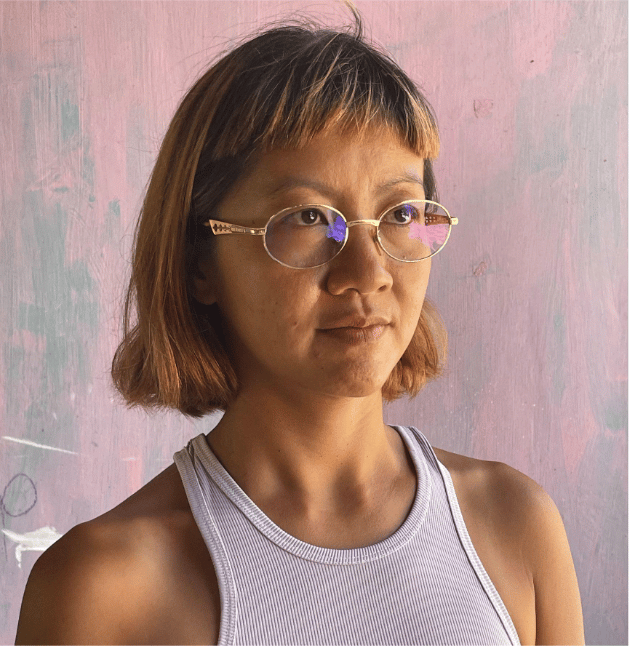
CATALINA AFRICA
Catalina Africa (b. 1988, Quezon City) considers shapeshifting and earth channeling to be her primary modes of expression.
She is a multidisciplinary artist who works in an array of mediums including painting, sound, sculpture, video, performance.
Her artworks are invocations to the natural landscape - they are spells, songs, love letters, prayers, maps, testimonies to the Earth’s mysteries and magic.
Africa lives and works in Aurora Province, Philippines with her husband and daughter, where she is currently cultivating a devotional practice to Spirit, transmuting Earth song, and continues to co-dream and collaborate with the living land. Africa is currently represented by Silverlens Gallery.
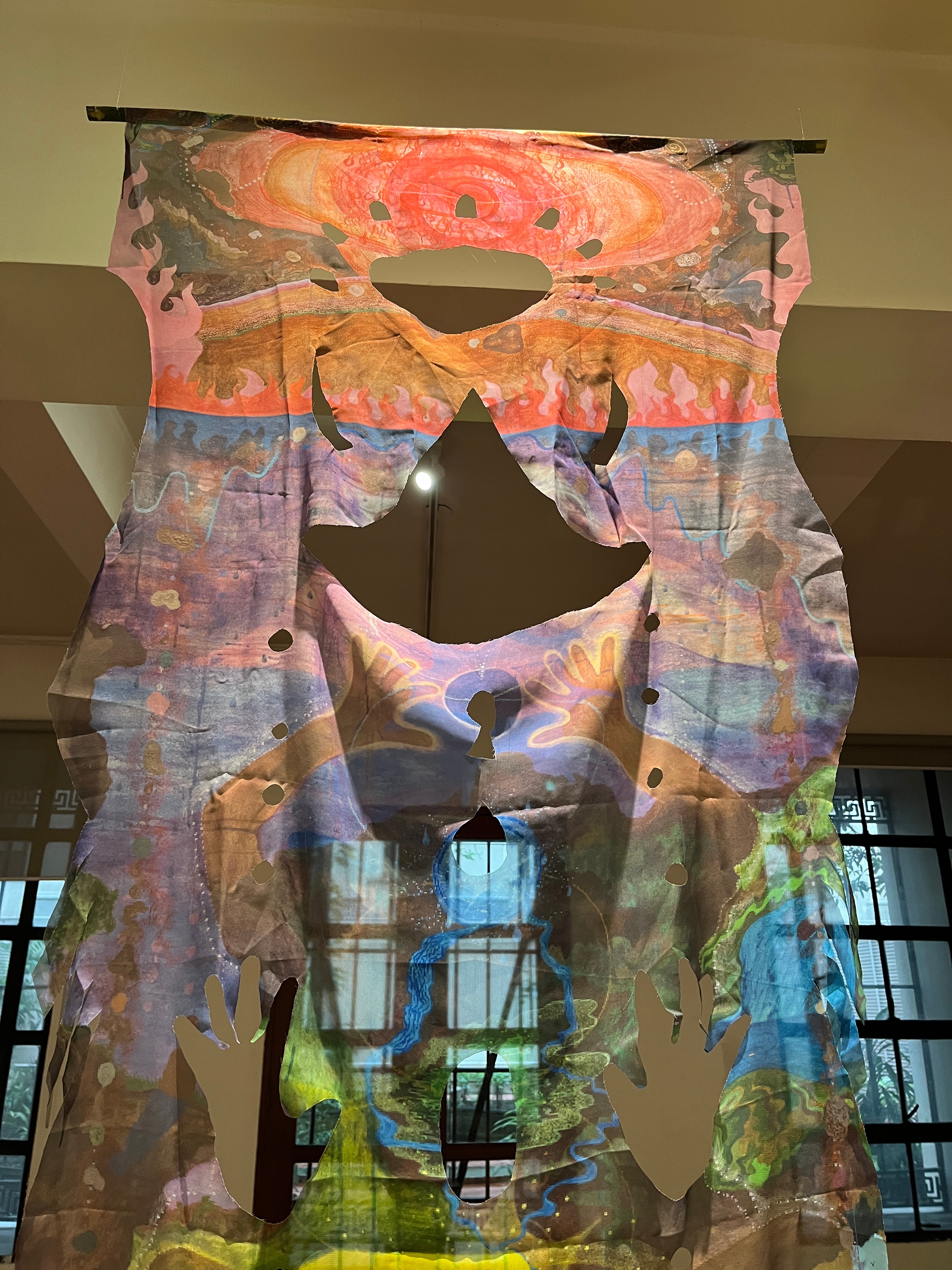
Catalina Africa, Earth Spirit Body Portals and Dreaming, PHANTOM, Printed chiffon, bamboo, 2025
Earth Spirit Body Portals and Dreaming
In this new sculptural installation, Catalina Africa transforms the gallery into a world where flowers tower over us, shadows harden into shrines, and raindrops shimmer as thresholds between earth and sky. Combining cement, resin, feathers, fabric, mirrors, and tarpaulin, she creates four human-scale figures anchored by a floor element shaped like roots or flames. Together, they form what she calls her “personal cosmology”—a landscape of spirits drawn from memory, meditation, and her sitio.
Africa’s work emerges from a long practice of painting landscapes that “speak back.” Here, she expands that dialogue into three dimensions, asking how the body feels awe in the presence of scale, light, and material contradiction. Flowers are no longer small and delicate but monumental; industrial cement carries water; synthetic glitter refracts natural light. These paradoxes embody the artist’s belief that nature is a teacher and that reconnecting with earth begins with wonder.
Rather than prescribing a narrative or ritual, Africa invites viewers to wander freely through the installation. Her aim is simple yet profound: to evoke feelings of magic, inspiration, and kilig. The installation is not a fixed story but a portal—a reminder that imagination can be an act of stewardship.
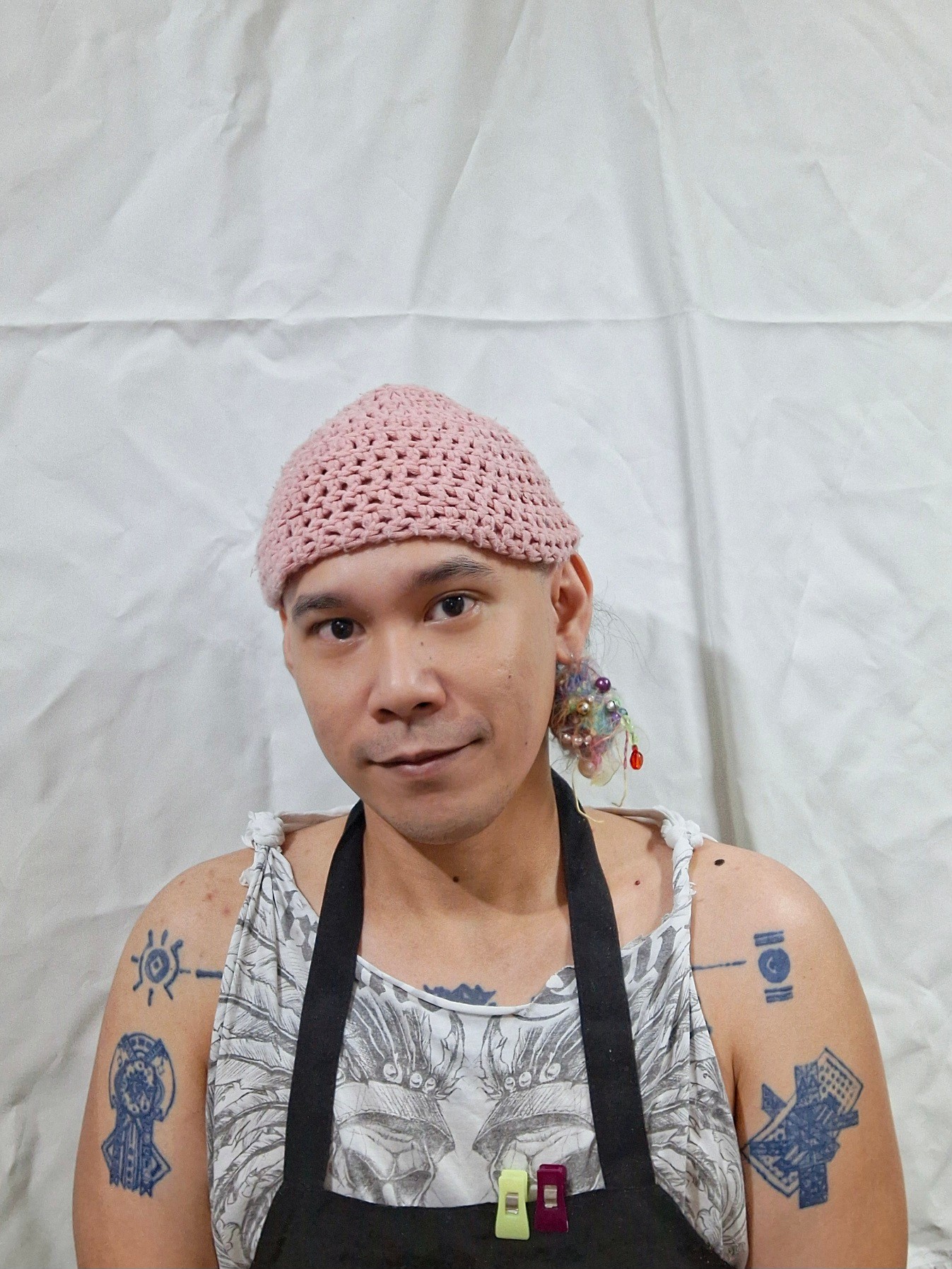
Denver Garza
Denver Garza (b. 1987, Manila) has an academic background in Psychology. Prior to pursuing art, he worked as a mental health worker.
His multidisciplinary practice ranges from painting, and mixed media crafts to participatory performances that contemplate the meaning and comfort in life and its uncertainties through the psyche and the psychosocial.
His works stem from intrapersonal dissection of identity, beliefs and social dynamics woven physically into a world through various media.
His exhibitions tackle various concerns and conditions such as the exploration of the self, family dynamics, internal transitions through resiliency. He attended an artist’s residency in Japan in 2018 and has conducted art therapy workshops in Manila. He currently resides in Bacoor, Cavite.
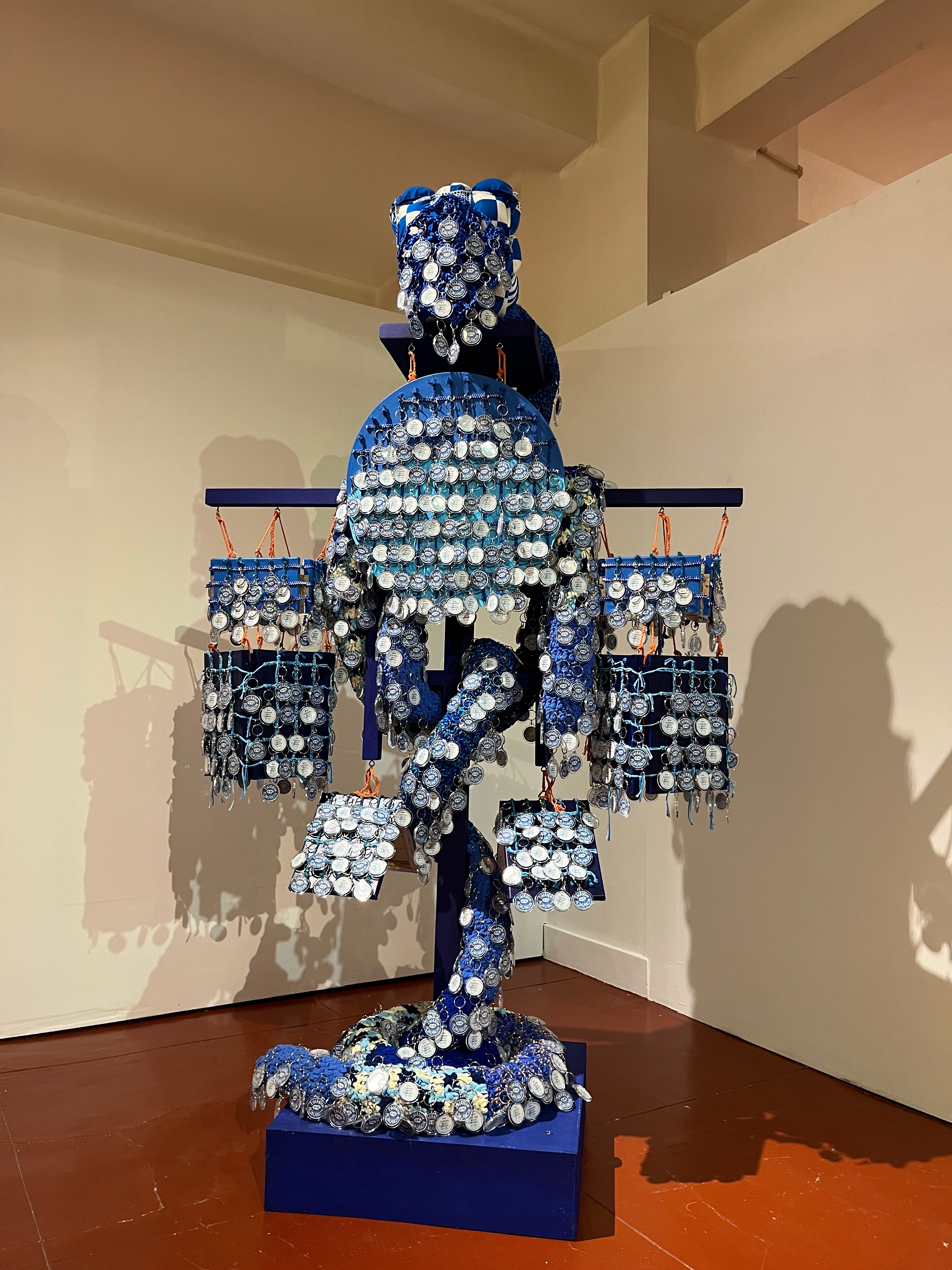
Denver Garza, Tagapagbitbit ng alinlangan, Custom key chain, various papers with thread, acrylic on stretched canvas and silkscreen, fiber filler, various crochet yarn, fabric and beads mounted on wooden structure, 2025
Tagapagbitbit ng alinlangan
Denver Garza’s installation invites us into an unfinished monument of care. Using stretched canvas, fabric, and an accumulation of everyday keychains, Garza creates a participatory sculpture that grows with the audience. Visitors are asked to contribute: to inscribe a burden on a red paper tag, to leave it behind, and to tie a keychain to the structure.
The form that emerges is not God, but a god—an imagined being that carries collective hope. Garza draws on memories of childhood devotionals, queer identity, and his past as a mental health worker, weaving ritual and therapy into a practice of communal release. The work resists the exclusivity of the art market by embracing the mass-produced keychain, transforming it into a vessel for personal reflection.
More than an object, the piece is an encounter. Each gesture—small, repetitive, and vulnerable—accumulates into a collective body. In this way, Garza’s work blurs the line between art and care, sculpture and ritual, personal memory and public offering. As Nicolas Bourriaud reminds us, art can operate as “a state of encounter,”¹ and Garza embraces this condition—where process, not permanence, becomes the ground of hope.
Russ Ligtas
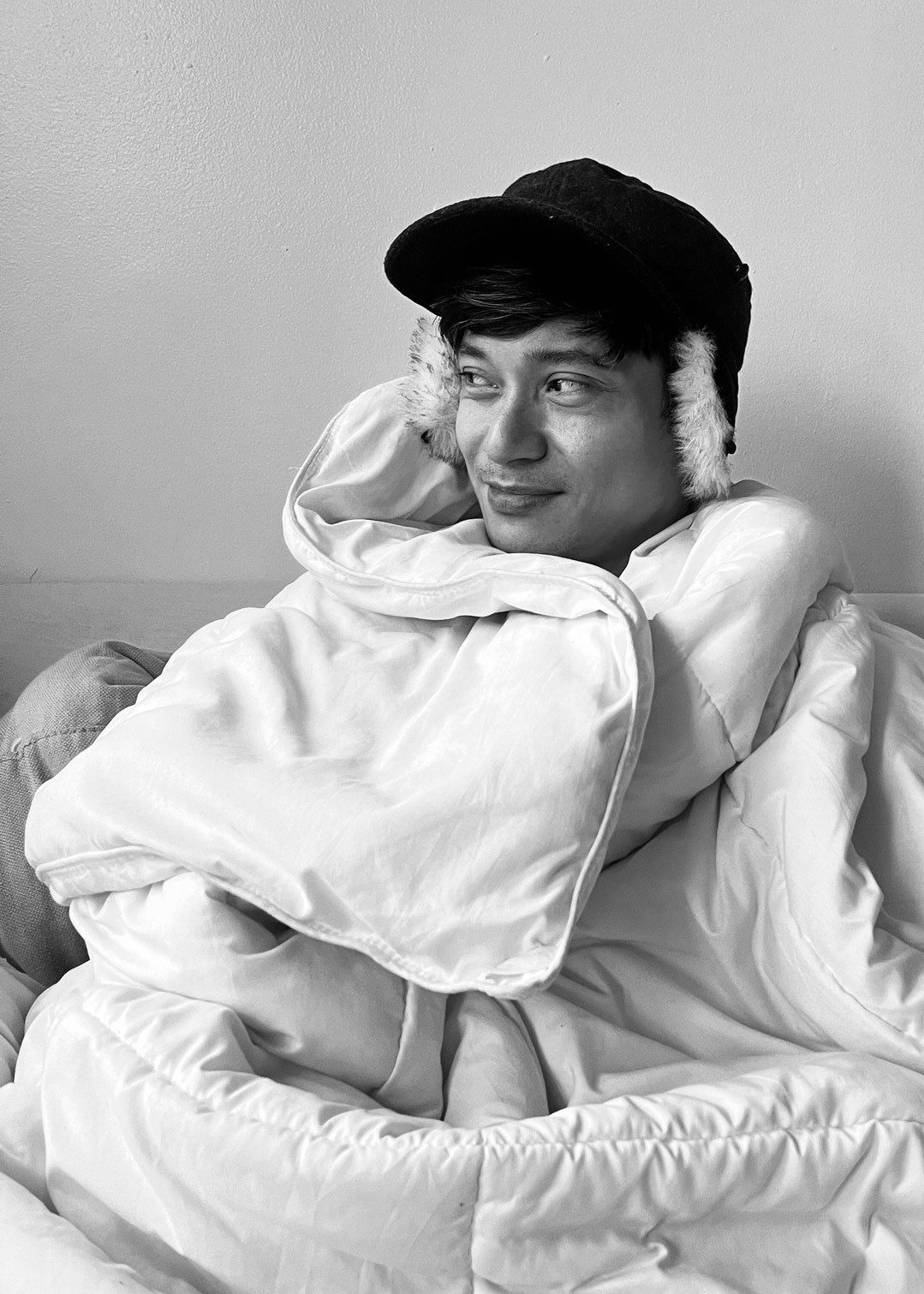
Russ Ligtas (b. 1985, Cebu City), a multi-disciplinary artist and performer, spans over two decades of diverse creative work and various collaborations in Cebu, Manila, and beyond.
His solo art, including live performance, installation, sculpture, painting, choreography, and film, draws inspiration from various alter egos, serving as conduits for his explorations of the Filipino body as an expanding mythological matrix and a living historical, geopolitical, and anthropological artifact.
Photo courtesy of Dane Terry
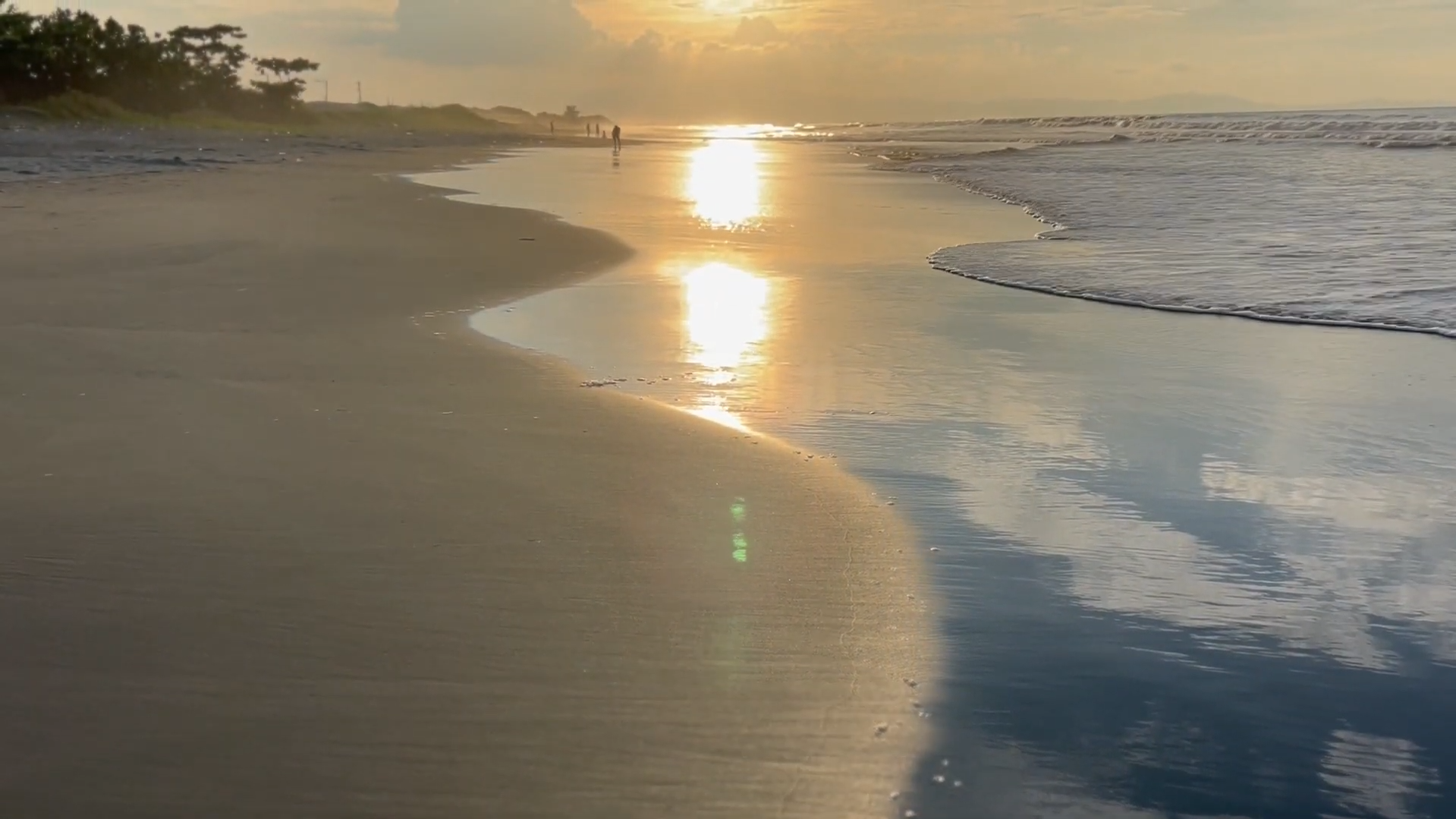
Russ Ligtas, The Last Hapi, Video installation, Running time: 90 minutes, 2025
The Last Hapi
Russ Ligtas’ The Last Hapi is an exploration of identity, memory, and myth, framed as both a ritual and a self-portrait. Drawing from his experience as a Filipino navigating diaspora, Ligtas weaves together fragments of history, personal narrative, and cultural imagination to question what “Filipino-ness” might mean today.
The work unfolds as a hybrid: a film that is also a ritual, a performance that becomes an installation. At its center is stillness—an insistence on breath and silence in a world crowded with noise. The presence of a seated figure within the space, watching alongside the audience, transforms viewing into an act of reflection and mirroring.
By referencing 1972, the year Martial Law was declared in the Philippines, the piece gestures toward historical trauma while refusing to fix meaning. The Hapi’s disappearance may serve as metaphor, allegory, or simply myth. In this way, Ligtas leaves room for multiple readings—academic, political, or personal.
The installation space, envisioned as either a dark cinematic environment or an intimate living room, invites audiences into a porous bubble of contemplation. Here, Ligtas offers not answers, but a mirror: a chance to see ourselves in contradiction, and perhaps to find grace in the reflection.
Ella Mendoza
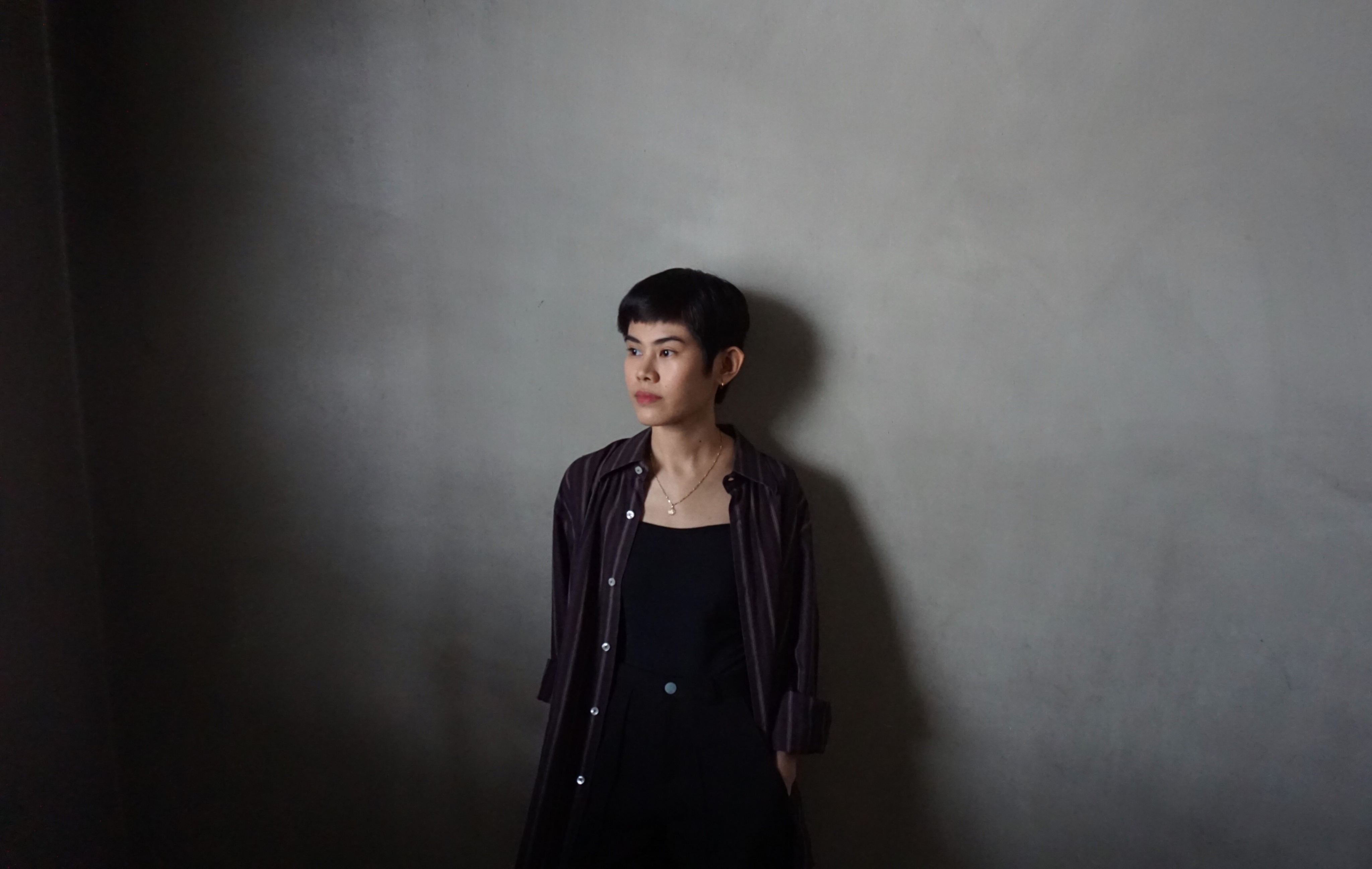
Ella Mendoza (b. 1993, Manila) started working with ceramics in 2015 while earning her BFA degrees in Painting (2014) and Art History (2017) at the University of the Philippines College of Fine Arts and has since been an active presence in the field.
Her practice in making functional wares in her early years later evolved into a play on contemporary counterparts of traditional vessels which later materialized in her conceptual, sculptural and installation work. She has held solo exhibitions with Artinformal Gallery and has participated in group exhibitions and art fairs in Manila and Bacolod, as well as in Singapore, Thailand, and Malaysia.
She has presented her work at the Australian Ceramics Congress, Art Fair Philippines 2022 Open Studios, and is a workshop presenter at The Ceramics School. She recently took part in the inaugural Maybank Foundation Artist Fellowship Program which was held in Bali, Indonesia last December 2023.
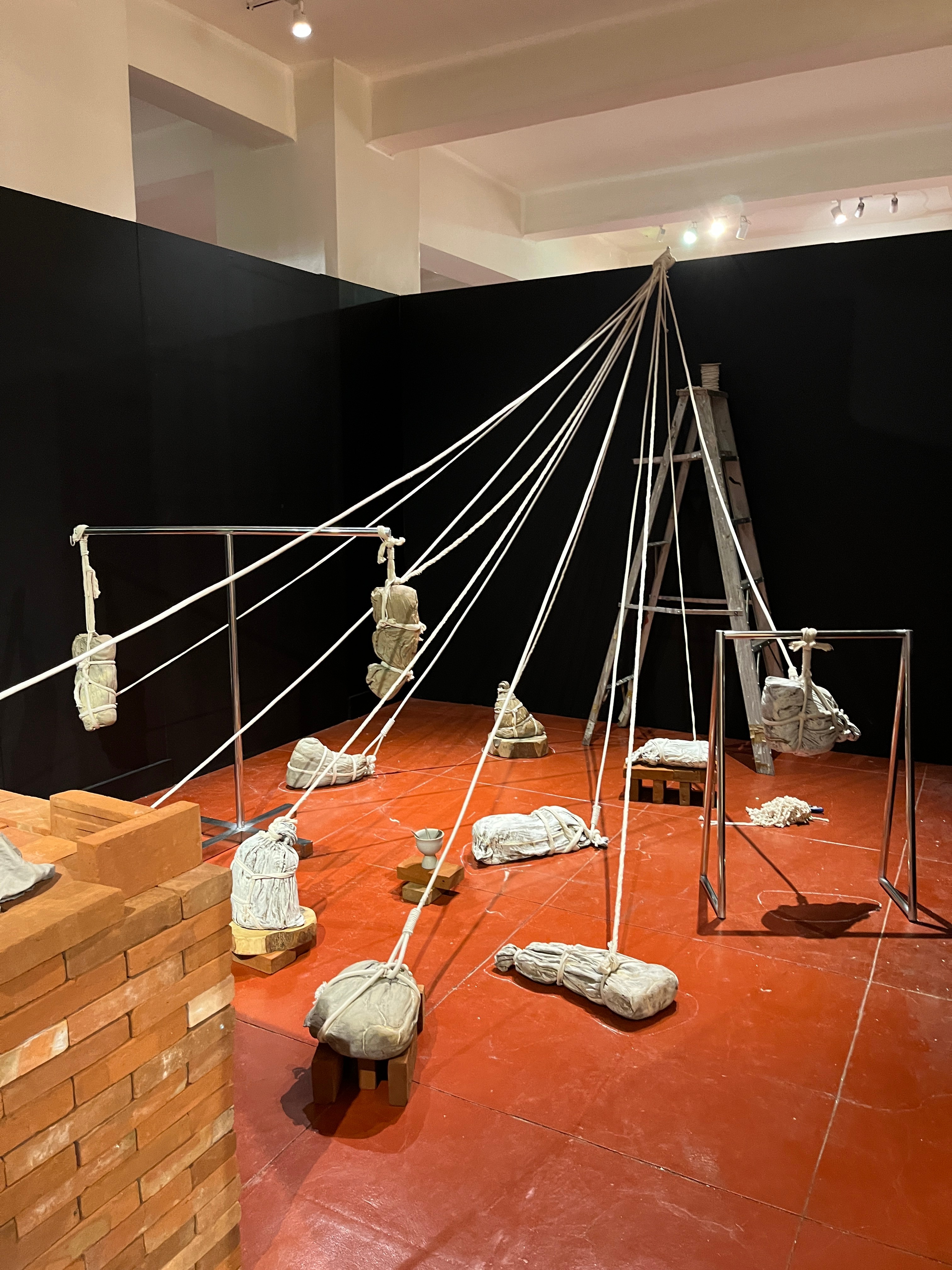
Ella Mendoza, Comfort of Contradiction, Stoneware, cotton rope, steel, terracotta bricks, 2025
Comfort of Contradiction
Ella Mendoza’s installation explores the psychology of cognitive dissonance—the tension of holding contradictory beliefs while refusing to reconcile them. Her forms evoke flesh, bone, and relic, yet never fully declare themselves. This ambiguity mirrors how societies absorb violence: through abstraction, compartmentalization, and silence.
At the center, a lamb on a clay brick plinth recalls religious sacrifice. But instead of redemption, it offers accusations. Around it, ropes descend in a triangulated array, suggesting both divine light and constriction. Chalk outlines trace absence like crime scenes, forcing the viewer to confront aftermath rather than spectacle.
Enclosed in graphite-gray walls, the space becomes a chamber of suspended judgment. Silence here is not neutral but charged, demanding that viewers notice their own reflexes of denial. Hal Foster’s discussion of abject and traumatic art shows how representation can fail not because of deficiency, but because it must reckon with the unassimilable.
Mendoza’s work does not offer answers. Instead, it stages the mechanisms by which we justify, compartmentalize, and live alongside violence—whether in faith, politics, or everyday life. In doing so, it asks us to reflect not on what violence is, but on how we manage to endure it.
Henrielle Baltazar Pagkaliwangan
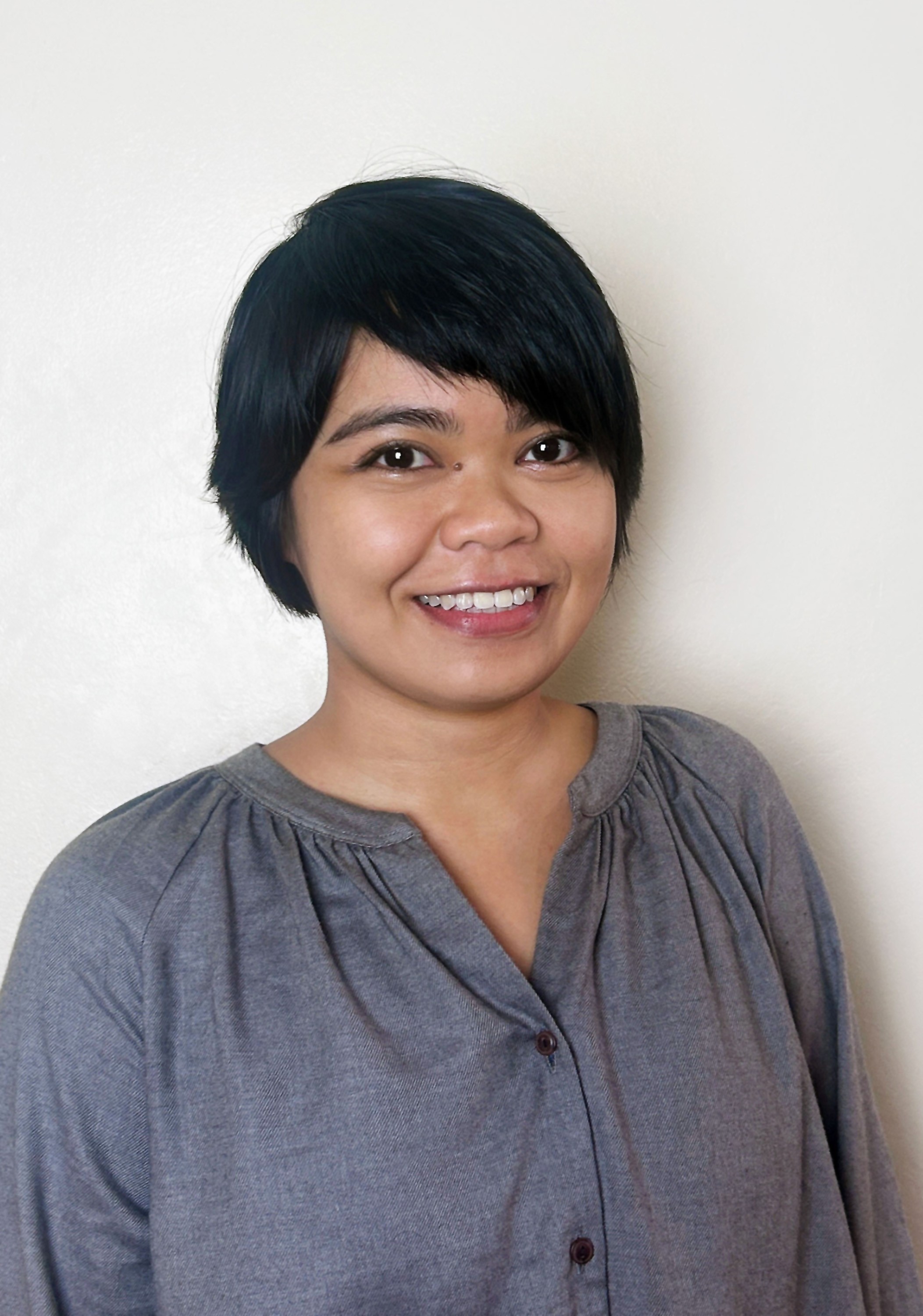
Henrielle Baltazar Pagkaliwangan (b. 1994, Cavite) explores stories behind mundane yet indispensable objects to examine Philippine history and material culture. Drawing from natural history illustration and taxonomy, she documents personal and historical narratives through hand-pulled prints and drawings.
Pagkaliwangan graduated magna cum laude from the University of the Philippines Diliman, College of Fine Arts (Major in Studio Arts) in 2015, where she also received one of the Department of Studio Arts Outstanding Thesis Awards for her undergraduate thesis titled Taxonomy Of Things. In 2017, she won the grand prize in the Don Papa Rum Art Competition, which included a one-month residency in Florence, Italy. Her work has been exhibited in solo and group exhibitions in the Philippines, Indonesia, Korea, and Taiwan. She is pursuing a Master of Fine Arts degree at the University of the Philippines, where she also serves as a teaching associate.
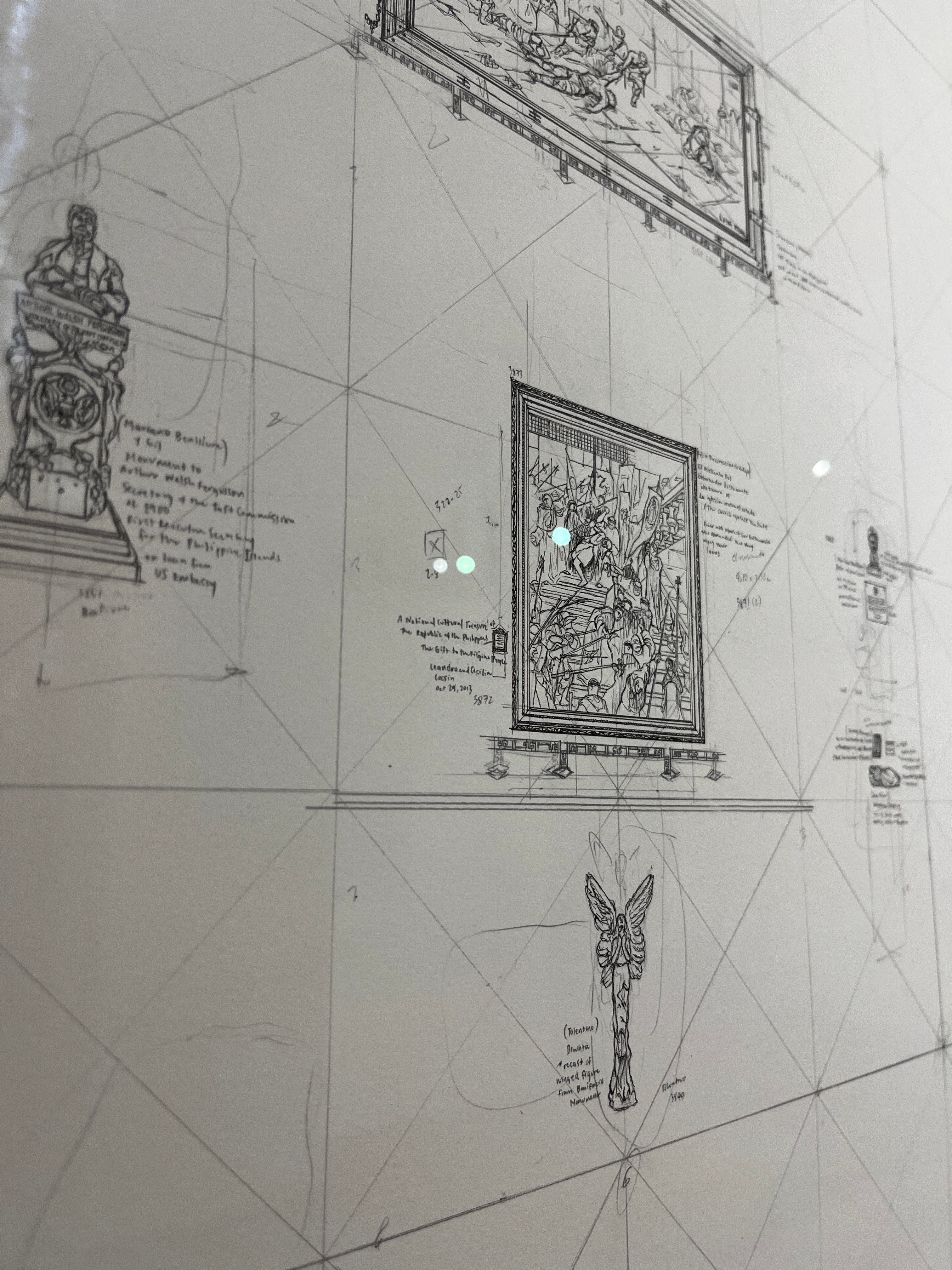
Henrielle Baltazar Pagkaliwangan, Becoming, in Fragments, Graphite, and pen and ink, 2025
Becoming, in Fragments
Henrielle Baltazar Pagkaliwangan turns to the ordinary: spoons, jars, fabrics, brooms, coins. She gathers these into typologies that resemble catalogues and inventories, but instead of sealing objects into fixed meaning, she keeps them unsettled. A spoon beside a reliquary, a broom beside a colonial coin—the pairings resist hierarchy, suggesting another way of telling who we are.
Her installation takes the form of a long scroll, a surface that unfurls across the wall and table. Unlike framed prints, the scroll refuses finality. It behaves like memory—expansive, fragile, always being rewritten. Printmaking here is less about repetition than about variation; each impression registers a shift, a small rupture in the familiar.
Pagkaliwangan interrupts the canon of “Filipino motifs,” inserting anomalies and distortions that reveal how unstable history remains. The colonial gaze lingers in our taxonomies, yet her work redraws them into something more provisional, more alive.
Critic Hal Foster has described the “archival impulse” as the artist’s drive to reprogram fragments of the past into new forms. Pagkaliwangan follows this path with tenderness, creating an archive that breathes.
What she offers is not resolution but becoming—an identity still in sketch, still unfolding.
Issay Rodriguez
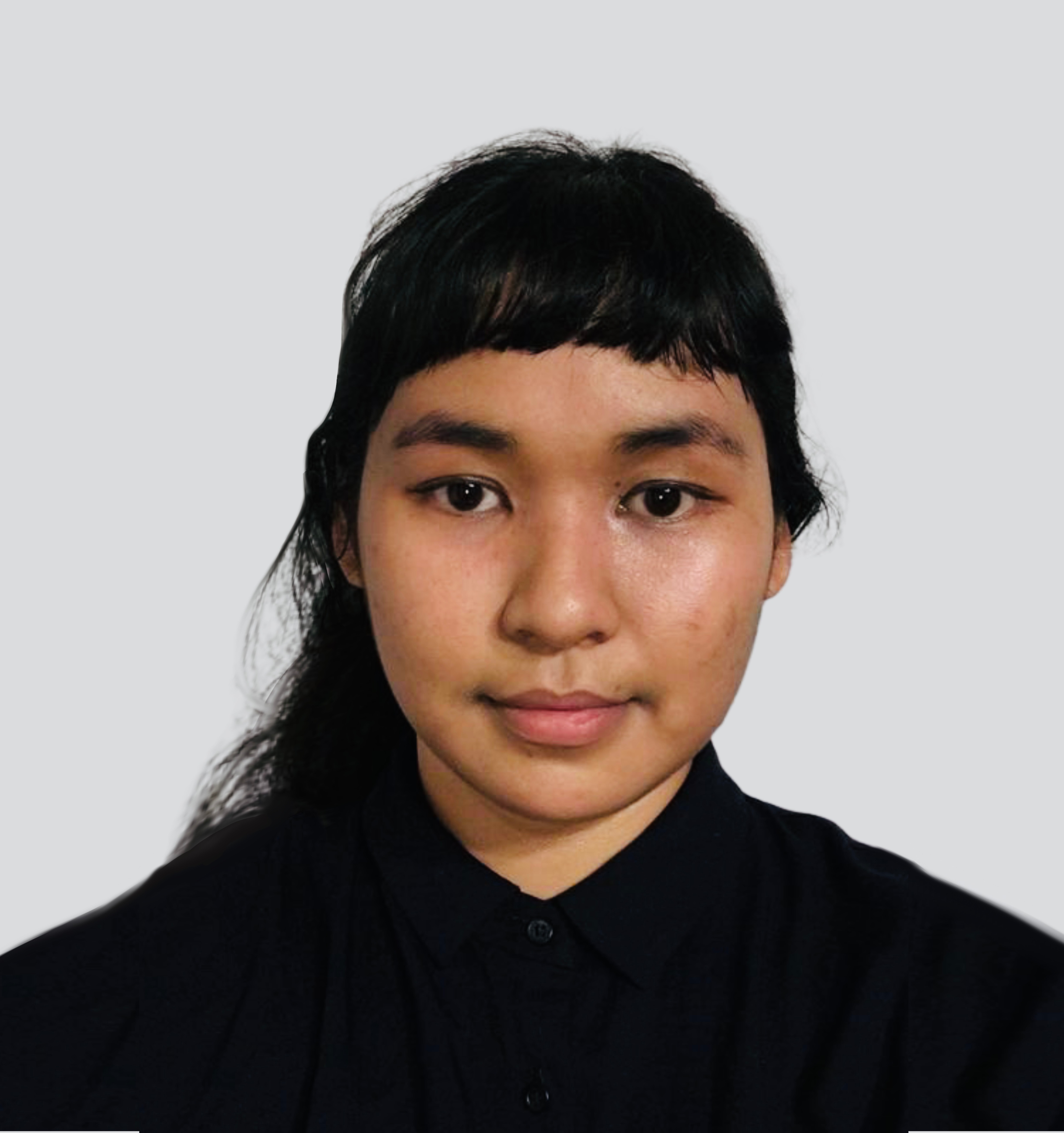
Issay Rodriguez (b. 1991) centers her current art practice on themes of humanism and ecology. Through archival research, community engagements, and interdisciplinary collaborations, she explores the articulation of thoughts, emotions, and values through art and technology.
She is an interdisciplinary artist, active member, and trustee for both the Philippine Botanical Art Society (PhilBAS) and the Philippine Native Plants Conservation Society Inc. (PNPCSI). She serves as the Assistant Director for the Healing and Regenerative Arts at Mahalina Foundation and lectures at the UP College of Fine Arts, Diliman. Her recent projects include solo exhibitions at Pintô Art Museum, Alliance Francaise de Manille, and workshops for the UP Vargas Museum, Fête De la Science in France, AVAT Taiwan, and Gasworks, London. She received the Benilde Open Design + Art Grant (2024), the Portfolio Art Prize (2020), and the Patnubay ng Sining at Kalinangan for Visual Arts (2017). She was also a finalist for the Fernando Zobel Visual Arts Prize (2018) and a UPCFA-Ecole Nationale Supérieure des Beaux-Arts Scholar, graduating with an Outstanding Thesis Award. In 2022, she represented the Philippines in the AFM-PARP Artist Residency in La Rochelle, France.
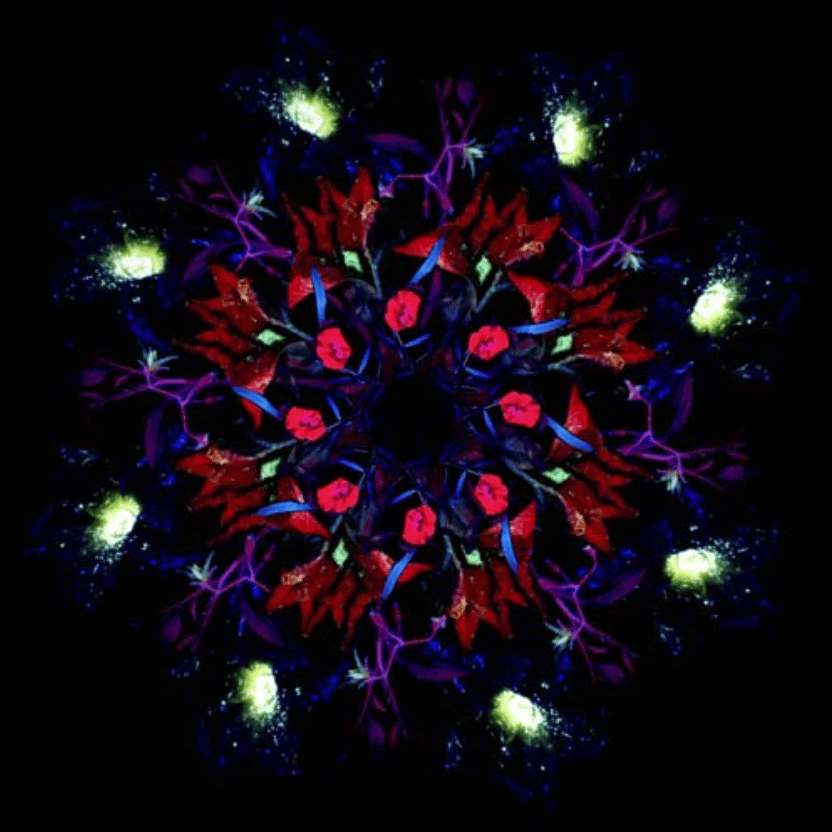
Issay Rodriguez, Cosmic Garden, collage of vegetable flowers photographed in UVIVF, 122 x 122 cm, 2022
Soil Eater Soil Healer
Star Eater, Soil Healer: Notes on Phytoremediation by Issay Rodriguez invites viewers into the hidden magic of plants and the regenerative possibilities of soil. Inspired by the rare Philippine species Rinorea niccolifera, which absorbs toxic nickel and restores ecosystems, Rodriguez transforms scientific observation into poetic visual narratives.
The exhibition’s study station includes drawings, cyanotypes, and motion graphics that reveal the plant’s capacity for transformation. Ambient whispers and soft poetry encourage reflection, curiosity, and slow engagement with the unseen processes of life beneath our feet. Visitors are invited to participate, linger, and form their own narratives about ecological resilience.
Rodriguez challenges conventional hierarchies of knowledge. Scientific documentation and artistic poetics coexist, and classification becomes a gesture of care rather than control. The exhibition fosters wonder, encouraging audiences to notice what is often overlooked and to participate in the quiet work of attention.
Star Eater, Soil Healer is a meditation on observation, care, and ecological responsibility. Through this work, Rodriguez shows that attending to the world, with curiosity and imagination, is an act of healing—both for the soil and for ourselves.
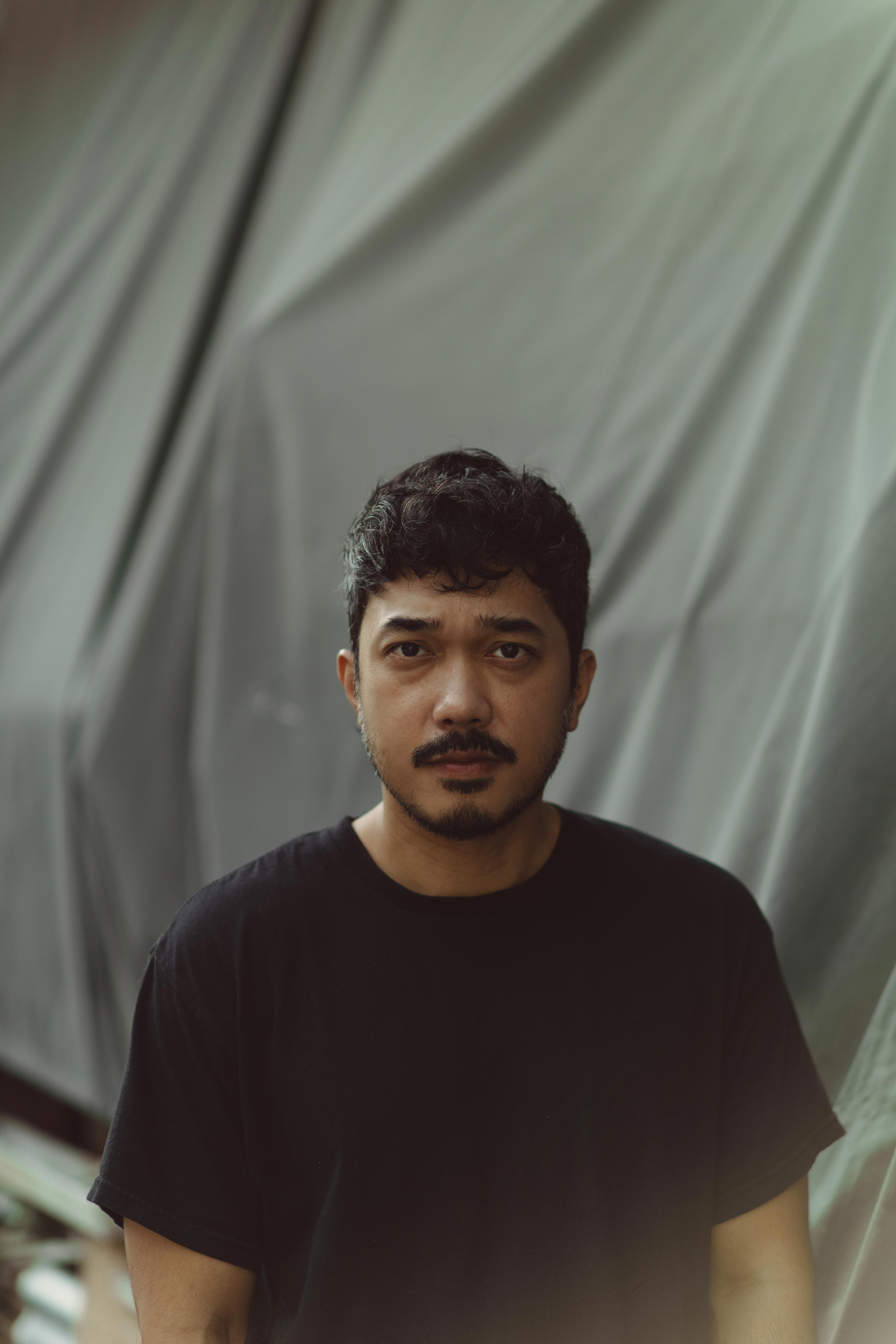
Luis Antonio Santos
Luis Antonio Santos (b. 1985, Quezon City) is a Quezon City-based visual artist whose work examines memory, entropy, isolation, and longing through painting and photography. Utilizing oil painting, printing, and image manipulation, he explores how recollections shift over time, employing everyday materials as metaphors for memory, space, and identity.
Exhibiting since 2010, Santos has held solo shows in Singapore (Fost Gallery) and Manila (Silverlens Gallery, West Gallery, Blanc, Finale Art File, MO_Space, Artinformal and the Drawing Room). He has participated in group exhibitions in Manila, New York (Jane Lombard Gallery), Beijing (Tang Contemporary), Singapore, Hong Kong, Athens, and Malaysia. He received the Fernando Zobel Prize and the Embassy of Italy Purchase Prize at the Ateneo Art Awards 2023, where he was previously shortlisted (2014, 2015). A finalist for the Sovereign Asian Art Prize 2023, he was also nominated for the Singapore Art Museum’s Signature Art Prize in 2018.
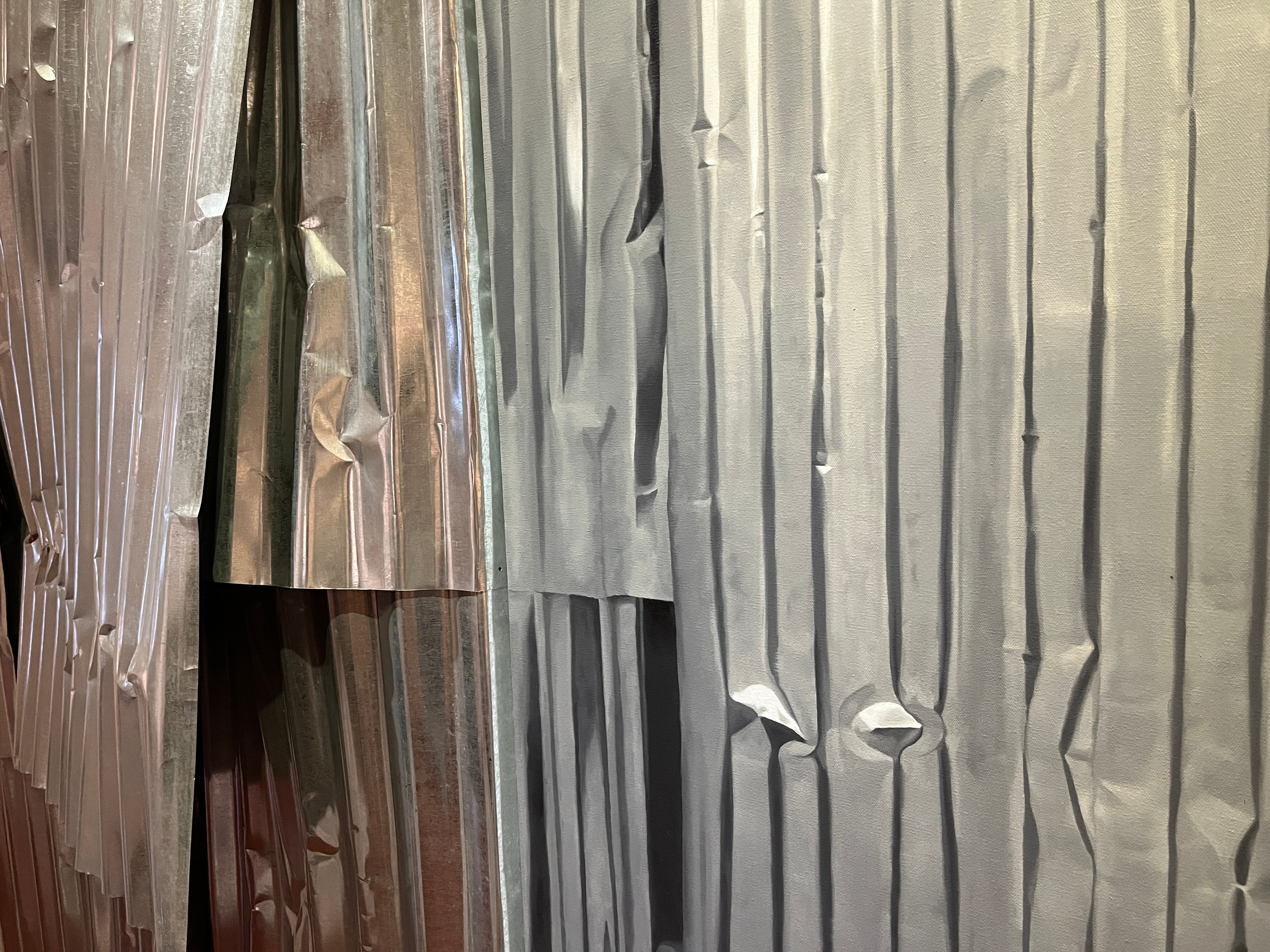
Luis Antonio Santos, Untitled (Structures), Oil on canvas/galvanised iron sheets mounted on stretcher (diptych), 2025
Untitled (Structures)
Untitled (Structures) pair iron sheets with their painted twins. Each groove, dent, and reflection carries time. Luis Antonio Santos captures the ordinary and lets it linger. Light shifts, shadows move, and the familiar becomes uncanny.
The diptych freezes an instant; the sheets continue to age, to reflect, to respond to the environment. The smaller Form/Void works isolate space and absence, inviting contemplation. Dim, quiet, almost altar-like, they draw attention to the unseen, the overlooked, the liminal.
Viewers are asked to look slowly, to notice subtle shifts. Boundaries between object and painting, form and void, past and present, blur. Everyday materials—the ubiquitous yero—become vessels for reflection, memory, and impermanence.
This exhibition encourages attention. Each encounter is unique. By noticing, we participate; by pausing, we inhabit space. Untitled (Structures) asks us to consider the quiet resonance of the familiar, the layered histories of material, and the delicate poetry of the everyday.
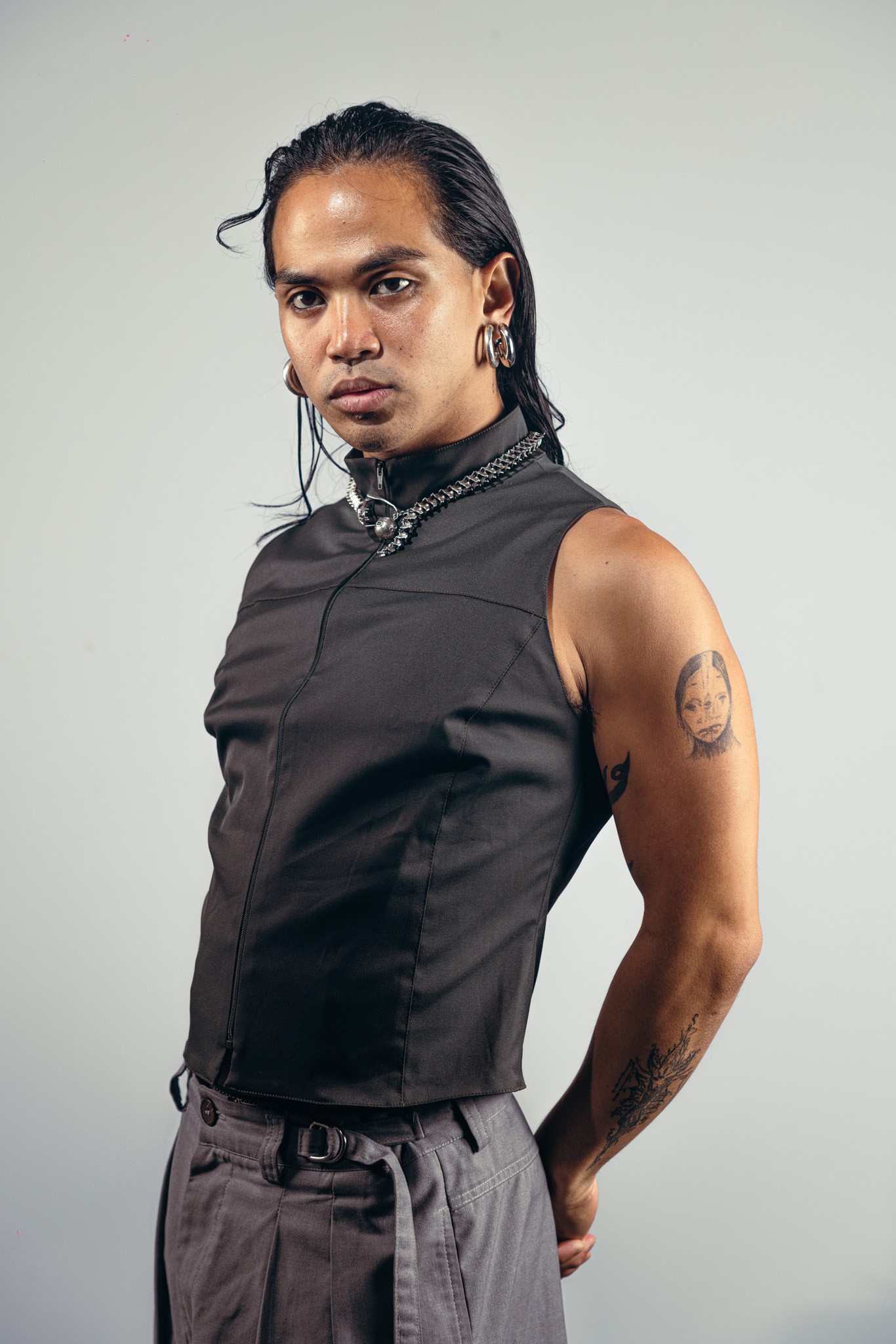
Joshua Serafin
Joshua Serafin (b. 1995, Bacolod City) is a multi-disciplinary artist who combines dance, performance, visual arts, and choreography. Born in the Philippines, they are currently based in Brussels. They are a house artist of Viernulvier for the season 2023-2027. Having graduated from the Philippine High School for the Arts where they majored in Theatre Arts, they moved on to major in contemporary dance at the Hong Kong Academy for Performing Arts. Joshua graduated from P.A.R.T.S. later on in 2019, and gained their Bachelors in Performance from KASK in 2021 where they also completed their Master’s in Fine Arts in Visual Arts in 2022 with great distinction.
Their Master’s work additionally earned them the Horliet-Dapsens Prij 2022,. They premiered their first solo work “Miss” in VIERNULVIER and have collaborated with multiple artists in Asia and Europe ranging from performance to visual arts. Their work has been shown internationally, most notably in, Esplanade, Singapore, BIT Teatergarasjen in Norway, Anti Festival in Finland , Nightshift in Ostende, Beursschowburg in Brussels, Tai Kwun Contemporary in Hong Kong, Haus Der Kulturen der Welt HKW, HAU Hebbel am Ufer in Berlin, and TONO Festival in Mexico.
They are also part of the Forbes list 30 under 30 Asia. They participate in the 60th International Art Exhibition of La Biennale di Venezia curated by Adriano Pedrosa. Their work VOID video installation, VOID live performance and PEARLS is part of “Foreigners Everywhere”.
Photo courtesy of Michiel Devijver
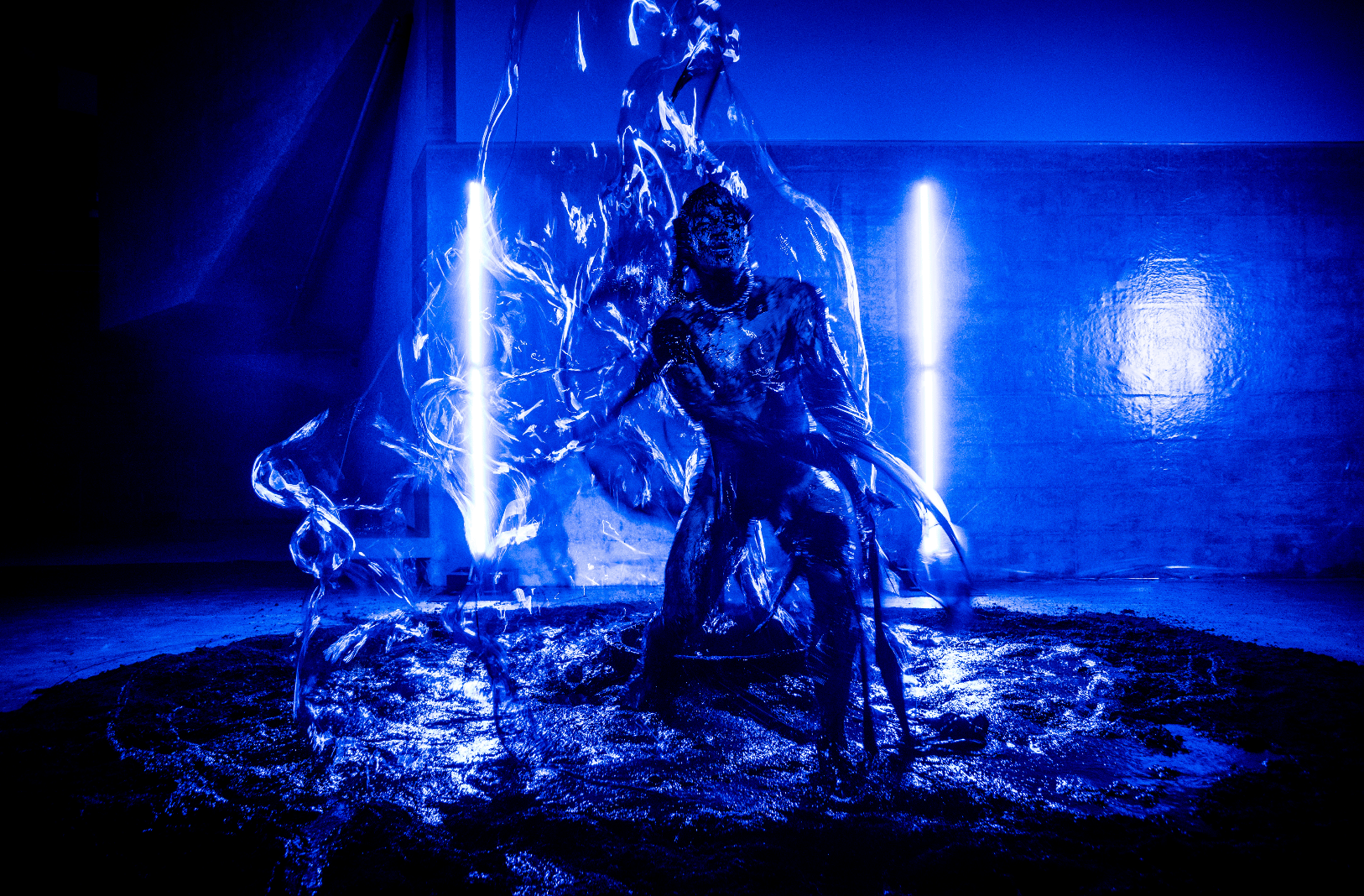
Joshua Serafin, VOID, live performance, 33 minutes, 30 seconds, 2024
Cosmological Gangbang
Bodies become stars, gods, memory.
In this three-part video installation, Joshua Serafin and collaborators reclaim what empire sought to erase: the sacred, shifting selves of precolonial gender-diverse identities in the Philippines.
Each screen offers a myth in motion:
PEARLS flows with ancestral femininity, a dance of song, liquid light, and ritual gesture. Creation Paradigm conjures celestial beings emerging from dark waters, a rebirth of deities for a new age.
VOID enacts a ritual of transformation, where body, spirit, and soil merge, creating a bridge between the earthly and the divine.
These works are acts of remembering, refusing erasure, and imagining futures. Collaborators’ movements expand, complicate, and queerness the narrative of identity and divinity. Sound, movement, and visual rhythm guide, disturb, and envelop the viewer, inviting reflection on the fluidity of time, spirit, and self.
Here, divinity is mutable. History is felt in flesh. Queer and trans bodies do not merely ask for space—they take it, beautifully, insistently, and undeniably.
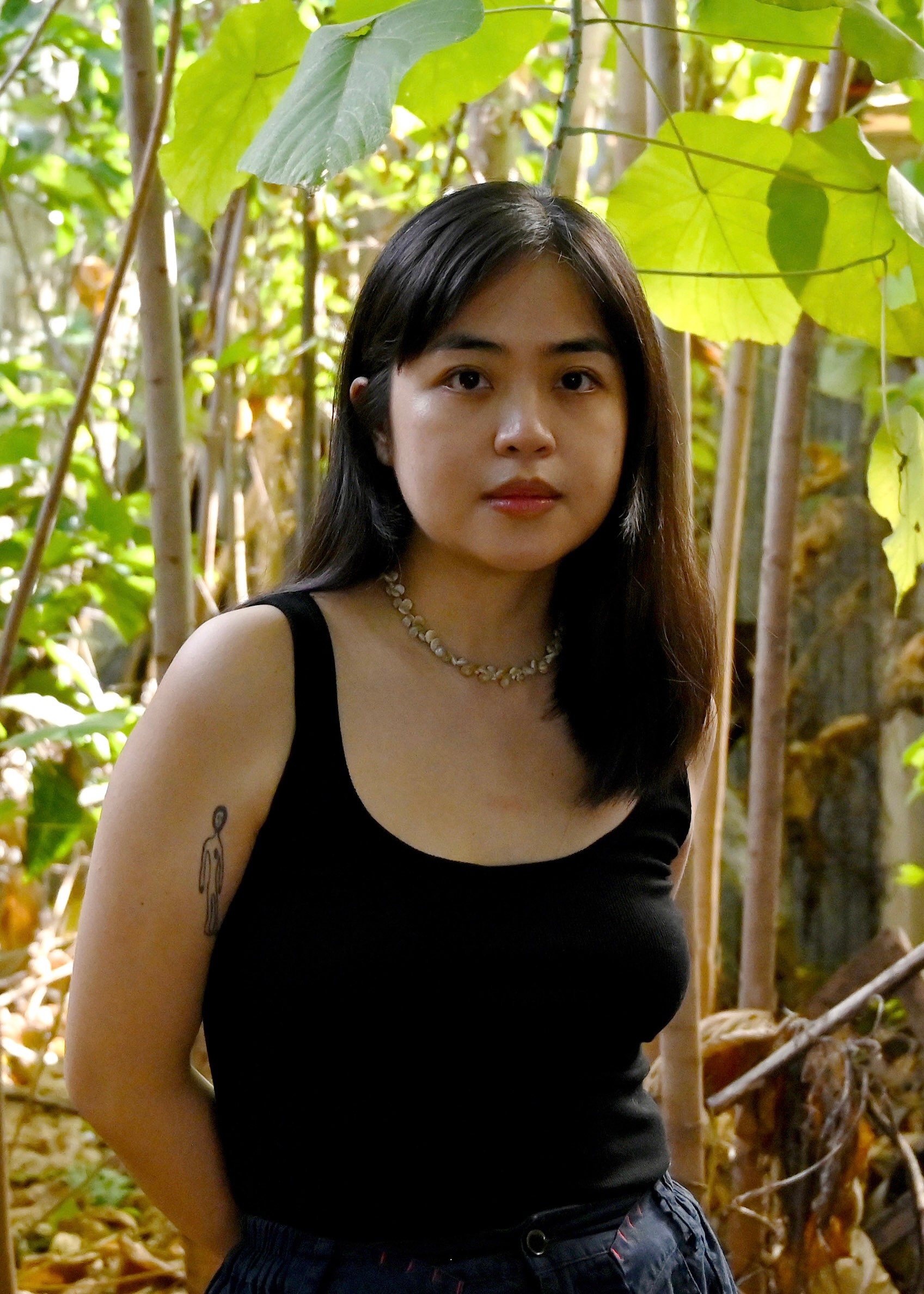
Jel Suarez
Jel Suarez (b. 1990, Quezon City) is a self-taught visual artist currently based in Bacolod City. She graduated with a BS in Psychology from the University of Santo Tomas (2011), and has completed courses towards an MA in Special Education through an academic scholarship from De La Salle University (2015). In 2014, she began exhibiting her works with various galleries, while holding a profession as a childhood educator.
Suarez worked on her artist practice full-time after her Southeast Asian residency at Rimbun Dahan in Malaysia (2017). Her solo exhibitions with West Gallery (2018 and 2020), and MO_Space Gallery (2019) were consecutively shortlisted for the Ateneo Art Awards, where she became the first recipient of its Italian Embassy’s Purchase Prize.
Suarez collaborated with contemporary artists and artist spaces in creating workshops for children through the Ateneo Art Gallery’s educational programs (2018-2021). She was a finalist for the Sovereign Asian Art Prize in Hong Kong (2022), and was recently an artist-in-residence at the Leipzig International Art Programme in Germany through the Goethe-Institut (2023-2024).
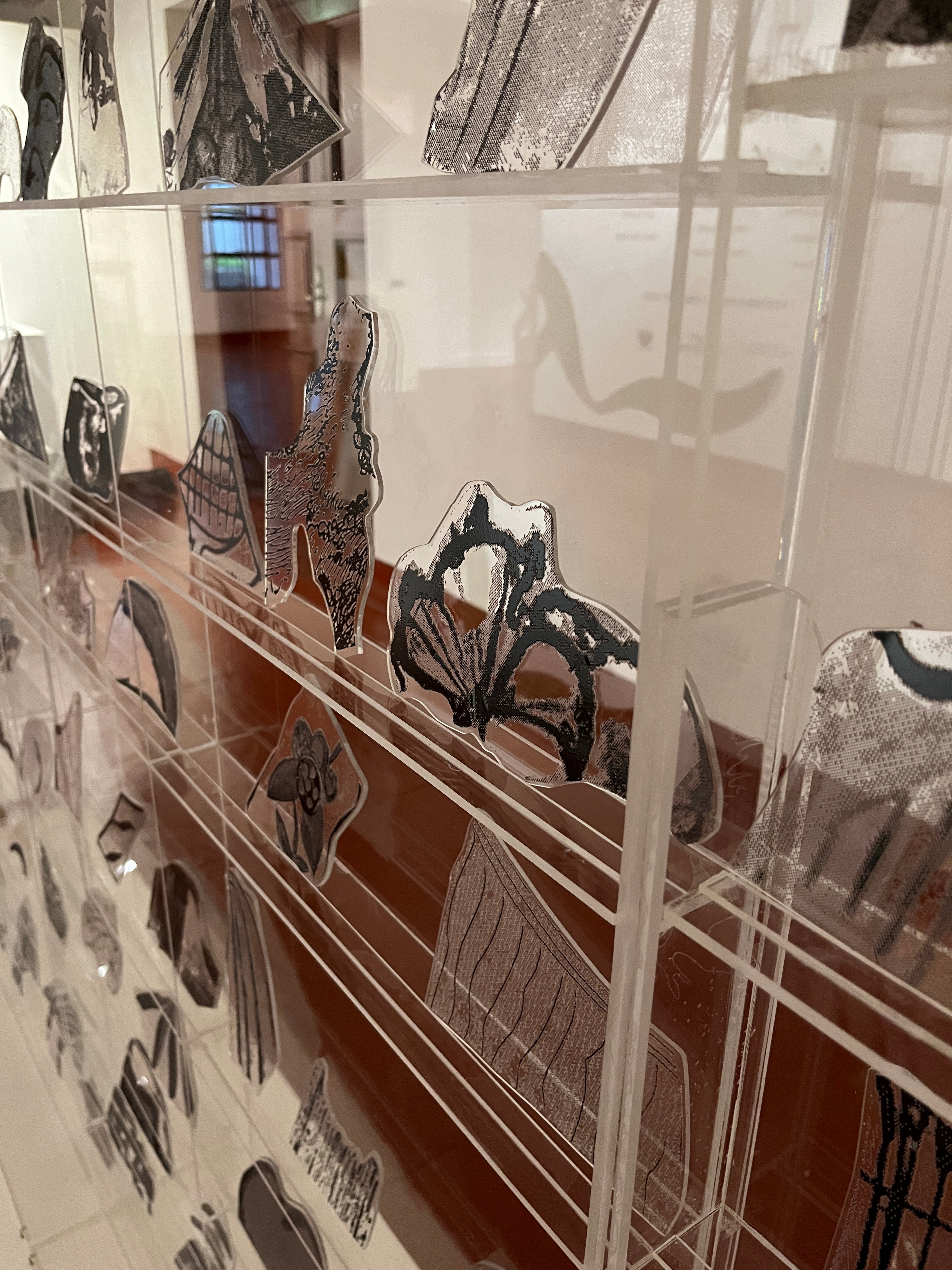
Jel Suarez, Specimens, Acrylic display shelf, acrylic components, image projection, 2025
Specimens
Jel Suarez’s cutouts gather quietly along the wall, each a fragment of life suspended in clear acrylic. She calls them “specimens,” though they are neither scientific nor cold—they are small records of care, memory, and attention. Born from her mother’s illness, childhood experiences of labeling objects in her grandmother’s pawnshop, and years of collecting fragments from books and collages, these works transform the ordinary into something intimate and resonant.
The acrylic catches light and shadow, folds and overlaps, creating layers that both conceal and reveal. Each piece invites careful looking, a pause, a moment of reflection. Arranged in a grid, the fragments create a rhythm that comforts while leaving space for wandering, for discovery. There is no single story here—only traces, whispers, echoes of domestic labor, archival practice, and acts of care, preserved in material form.
Suarez’s specimens ask us to notice the small gestures: the cut, the fold, the layering of fragments. Ordinary materials, when attended to with tenderness, carry weight and meaning. In this quiet insistence, we find intimacy, resilience, and memory made visible—a meditation on how the fragments of our lives, carefully observed, can speak to the universal.
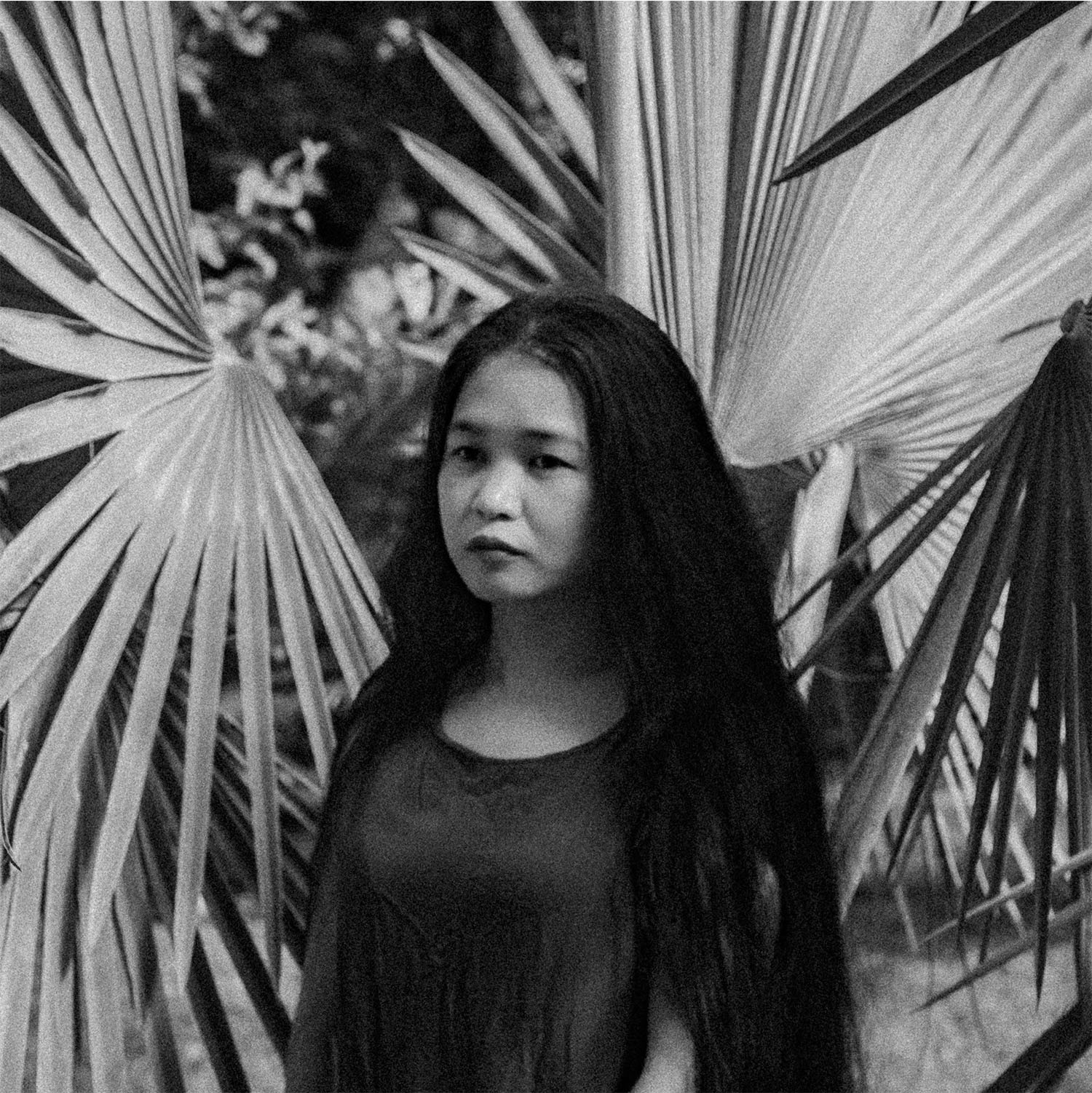
Tekla Tamoria
Ma. Athela "Tekla" Tamoria (b. 1989, Quezon City) graduated with a degree in Painting from the University of the Philippines College of Fine Arts in 2010. After two years of working in the corporate sector, she pursued tailoring at a local technical school allowing her to further her practice of working with textiles. She has completed residencies at the Beppu Project in Japan (2023) and at ABungalow in Talisay (2024).
Tamoria has been a featured artist in art fairs such as Art in the Park 2018 and at the Asia Now Paris Art Fair in 2018 by representation of Vinyl on Vinyl. She had works included in two museum exhibitions: More than a Hat at the Metropolitan Museum of Manila (2022) and Variation of the Fields at Vargas Museum (December 2019). In 2023, Tamoria was one of the Ateneo Art Awards (AAA) Fernando Zóbel Prizes for Visual Art winners with an upcoming residency at NoSpace in Baguio.
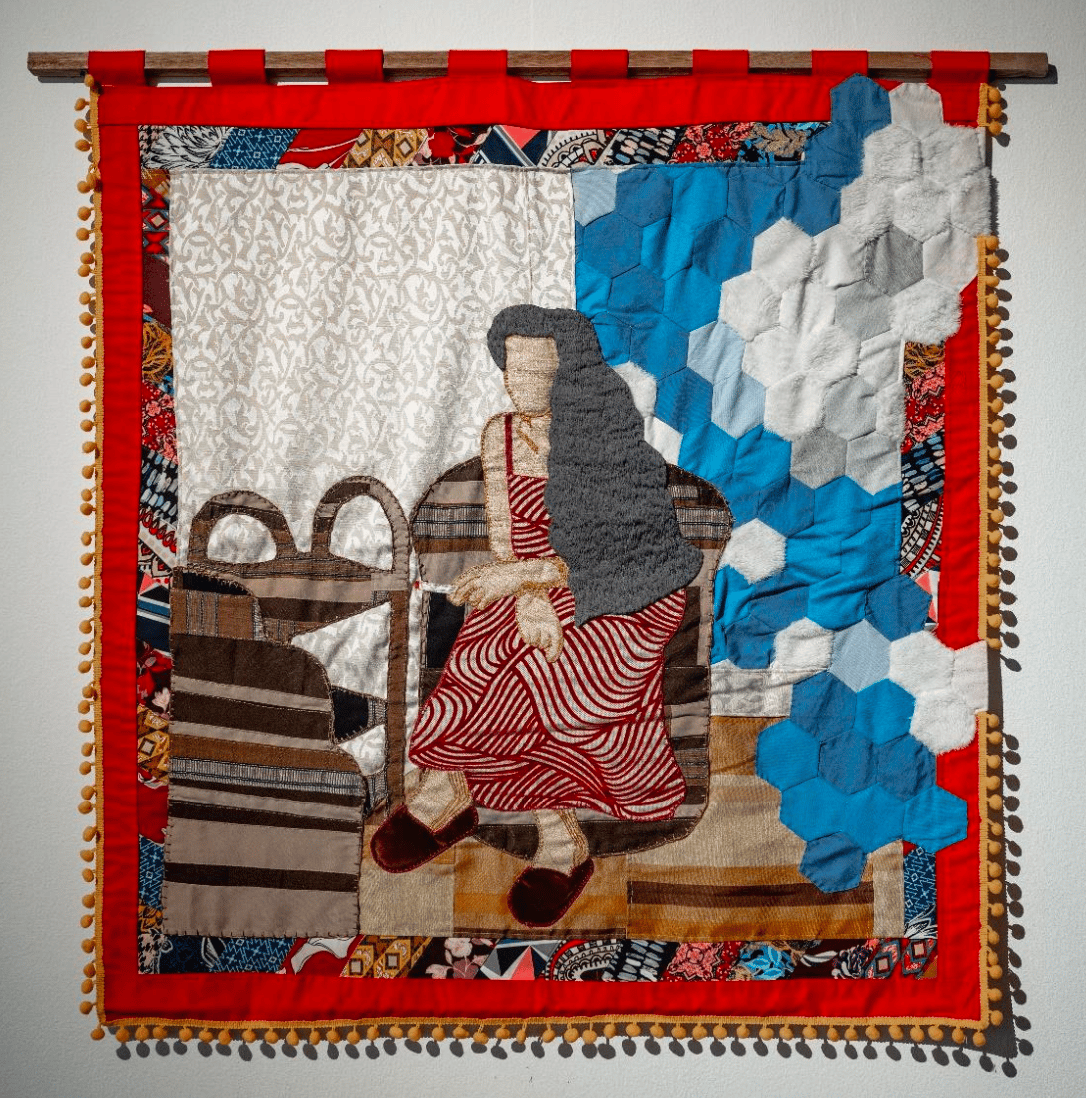
Tekla Tamoria, Sa may kanto nagkakape, tapestry, 97.7 x 90.1 cm, 2020
What a Journey It Has Been
A tapestry thirty feet long unfolds like a diary stitched in cloth. Using recycled fabric, beadwork, and quilting techniques, Tekla Tamoria weaves together three overlapping journeys: her passage from childhood to adulthood, her daily experience as a commuter along EDSA, and her path to becoming an artist.
The work is both personal and collective. Landmarks, religious symbols, vehicles, and fragments of family life appear across the textile, echoing the textures of urban survival and middle-class Filipino identity. Its title — borrowed from a Lea Salonga ballad — sets the tone: tender, humorous, and resilient. Humor, for Tamoria, is a deliberate strategy, a way of observing life’s challenges while transforming them into something we can hold.
Fabric is Tamoria’s natural medium. Inspired by her grandmother, a dressmaker, and further trained in dressmaking herself, she treats sewing as both skill and storytelling. The tactile richness of her beadwork and stitched details speaks of time, patience, and intimacy.
While deeply self-referential — a visual self-portrait in fragments — the tapestry also gestures outward. In honoring jeepneys, faith, and everyday struggles, Tamoria’s journey becomes ours: a shared fabric of memory, mobility, and becoming.
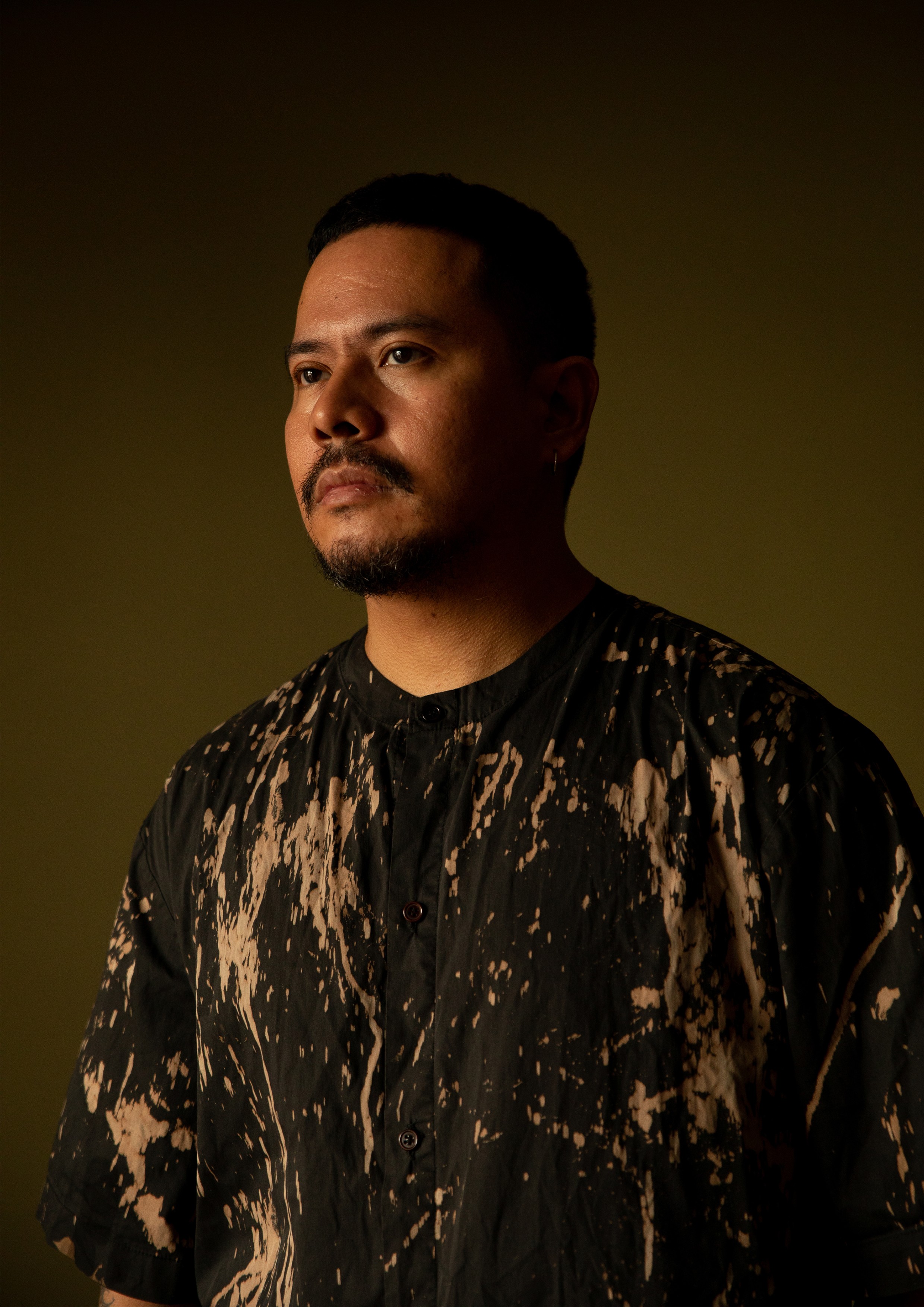
Derek Tumala
Derek Tumala (b. 1986, Manila) is a visual artist staging various media and subjects in the pursuit of ecological world-making. Tumala’s wide-ranging scope of practice explores the possibilities of art in the form of knowledge, schematics, living systems, object orientation, moving image, emerging technologies, staged performance or public program.
His art practice revolves around the realms of science and nature meditating on the idea of interconnectedness. By forming ecologies and systems of thought, Tumala’s practice traces mutuality between human and its changing natural and built environments.
Tumala’s diverse art practice has led him to present projects at the Museum of Contemporary Art & Design-Manila, World Weather Network, Jogjakarta Biennale, International Rice Research Institute, Manila Observatory, Delfina Foundation, UK, Sainsbury Centre, UK, Art Basel Hong Kong and more. In 2024, Tumala was named one of ArtReview Magazine’s Future Greats.
Photo courtesy of Geric Cruz
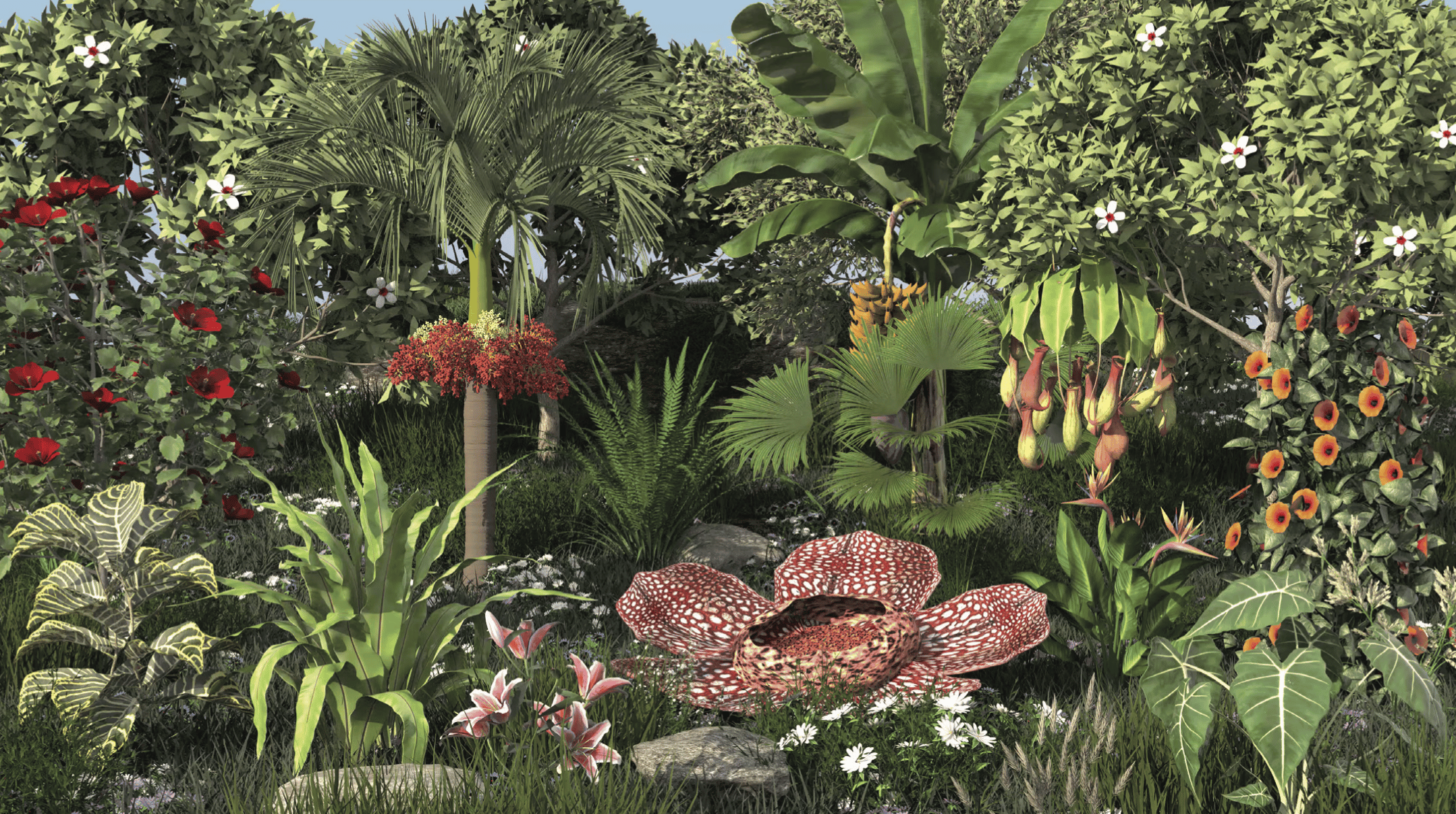
Derek Tumala, Kayamanan ng Pilipinas (Treasures of the Philippines), LED wall, video, color, Javascript codes, CPU, Climacell Weather API, 10 x 6 m, 2021-2022
Vanishing Tribe
Some disappearances are loud—broadcast, mourned, historicized. Others happen slowly, almost silently. Vanishing Tribe draws attention to the quiet violence of erasure.
In this work, Derek Tumala places side by side two vulnerable forms of life: endangered species and artists—queer, women-identifying, Filipino. The two-channel video alternates between taxidermied animals inside the National Museum of Natural History and portraits of living artists who, like those animals, survive within systems that threaten their existence.
It is not a simple metaphor. The parallel is material, embodied. What connects these vanishing lives are the legacies of colonialism, environmental collapse, hypercapitalism, and policies that privilege profit over life. The extinction of animals and the precarity of artists are not isolated tragedies; they are symptoms of the same world order.
Tumala does not offer spectacle—he offers pause. A space to reflect on who gets archived and who gets forgotten. Who is protected by institutions, and who is left to fend for themselves.The act of gathering, making visible, insisting on presence, becomes a quiet protest.
Pay attention. What vanishes does not always return.
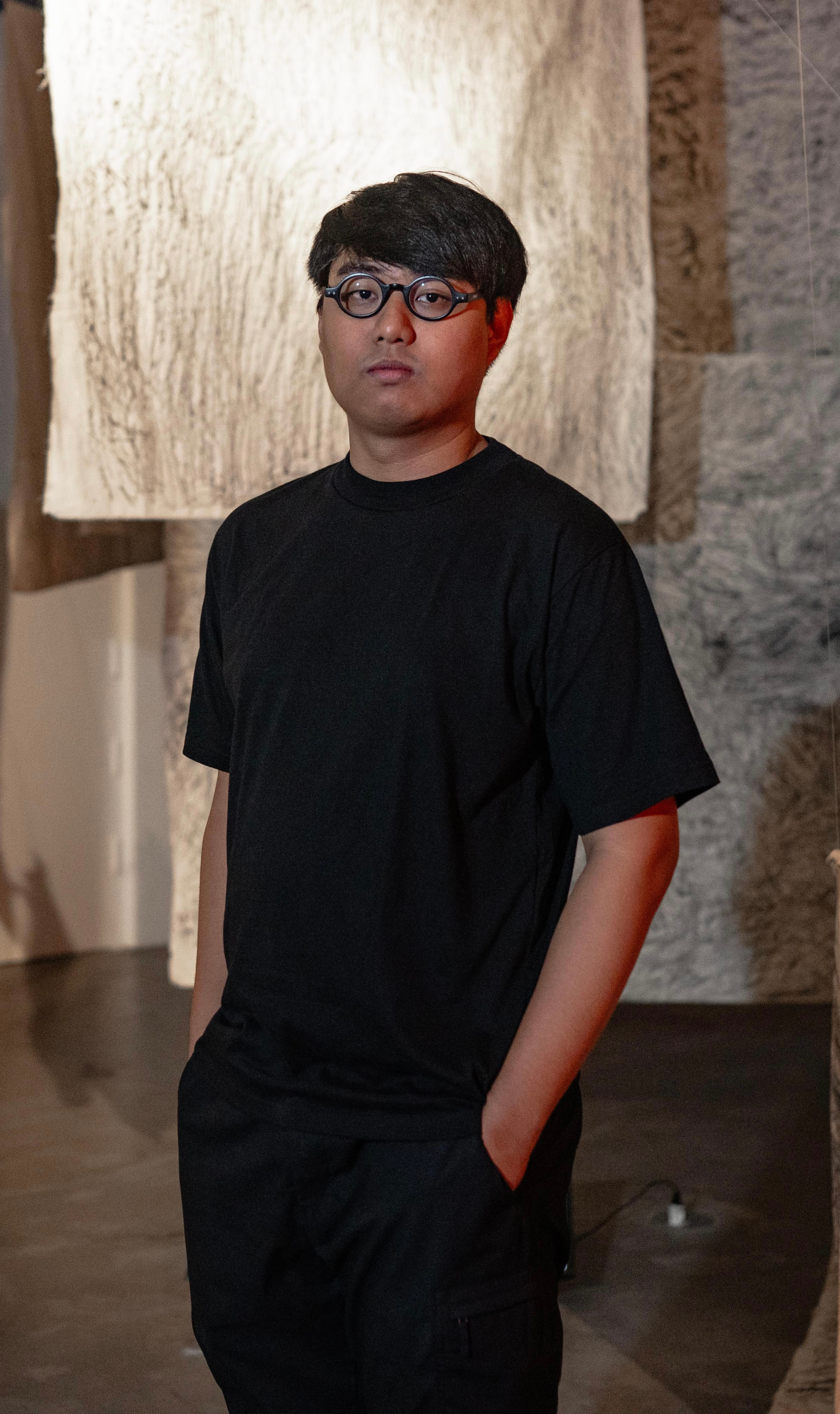
Vien Valencia
Vien Valencia (b. 1998, Quezon City) situates his work at the intersection of community, time, site, process, and anthropology. In 2023, he won the Ateneo Art Award for your age, my age, and the age of the river, a collaboration with the Dumagat-Remontado indigenous group facing a grave threat to their way of life due to a dam construction that will submerge their river, villages, and livelihoods.
Singapore Art Museum commissioned Valencia’s imprint of an imprint of an imprint, an extension of the artist’s developing research into the Tinipak River in Tanay, Rizal and Quezon Province, Philippines, and its surrounding communities. He works on alternative archive projects, tied together by an interest in challenging traditional methods of archiving, such as the gradual sinking of barangays in Bulacan and the Badjao group’s exodus from Mindanao to Manila.
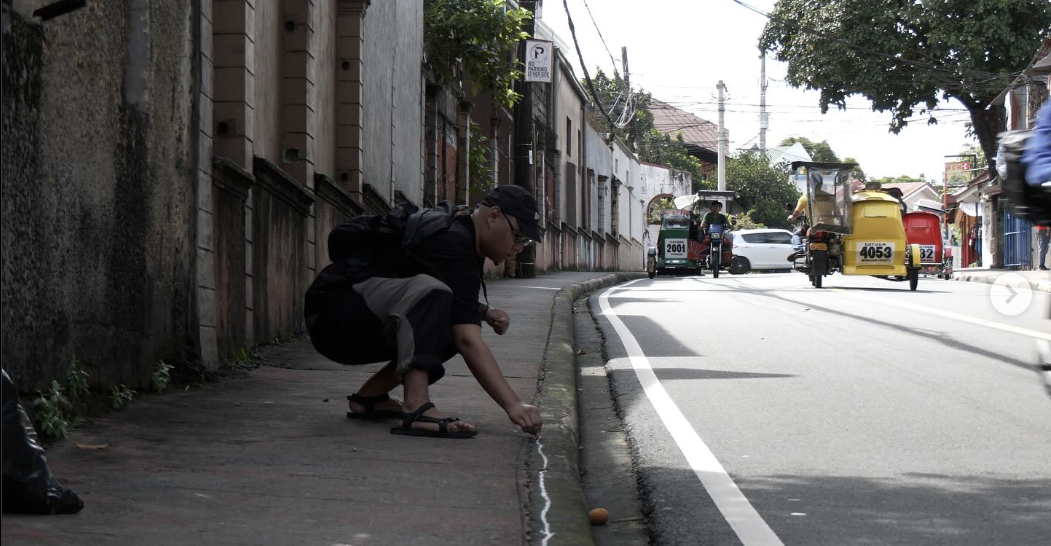
Vien Valencia, Long Drawing, Single-channel video installation, Running time: 3 hours, 33 minutes, 47 seconds, 2025
Long Drawing
Vien Valencia’s Long Drawing begins with a simple act: chalk and/or crayon pressed to the ground, feet moving forward, a line left behind. Yet this mark is more than a drawing—it is a record of displacement.
As a child, Valencia notices that his school ID’s carry a new address. His family moved constantly, pushed by eviction and survival. What seemed temporary became a cycle of uprooting. Chalk and crayon, like memory, is fragile: it can be erased, smudged, paved over. Still, each line carries the weight of a journey, of bodies in search of permanence.
Unlike traditional drawings on pristine paper, Valencia chooses the streets—overlooked, burdened, humble—as his picture plane. To draw his path from current home to previous, honor the movement itself, to trace an archive of survival across city streets.
The imagined distances and connections of Long Drawing would exceed any gallery wall. What you encounter here is a video installation that gestures toward the impossible scale of displacement. Valencia’s work is not about nostalgia but about grounding—asking what it means to belong when belonging is always at risk.
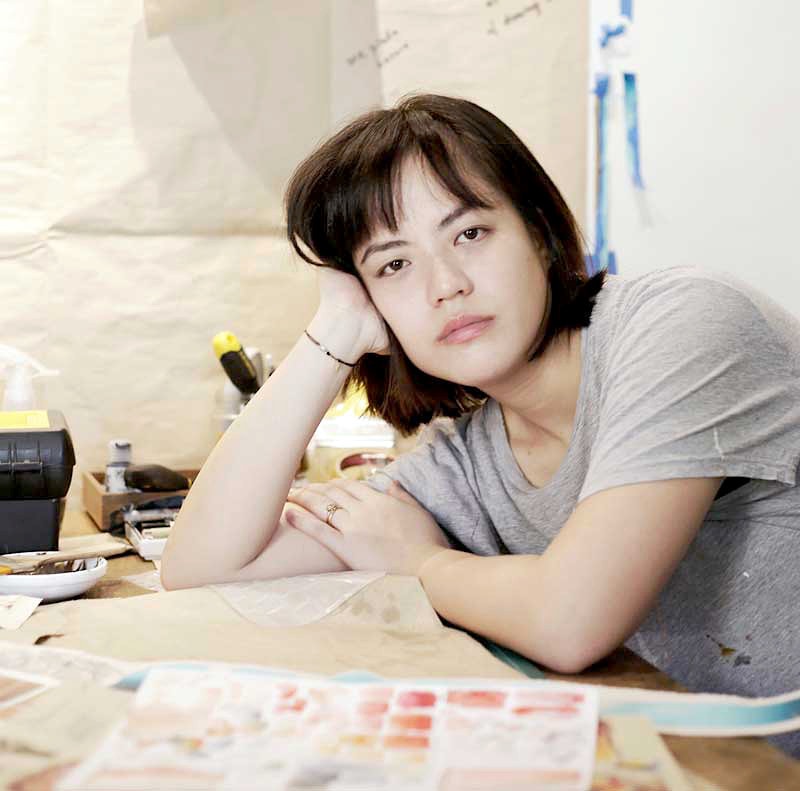
Liv Vinluan
Liv Vinluan (b. 1987, Manila) graduated from the College of Fine Arts at the University of the Philippines in Diliman and has been exhibiting her work for the past sixteen years. History remains as the singular, defining cornerstone of her work.
Now 37, she continues her investigations on death and mortality, the cyclicality of histories, the inconsistencies of human character and behavior, and the passage of time. She lives and works in the hills of Antipolo, Rizal.
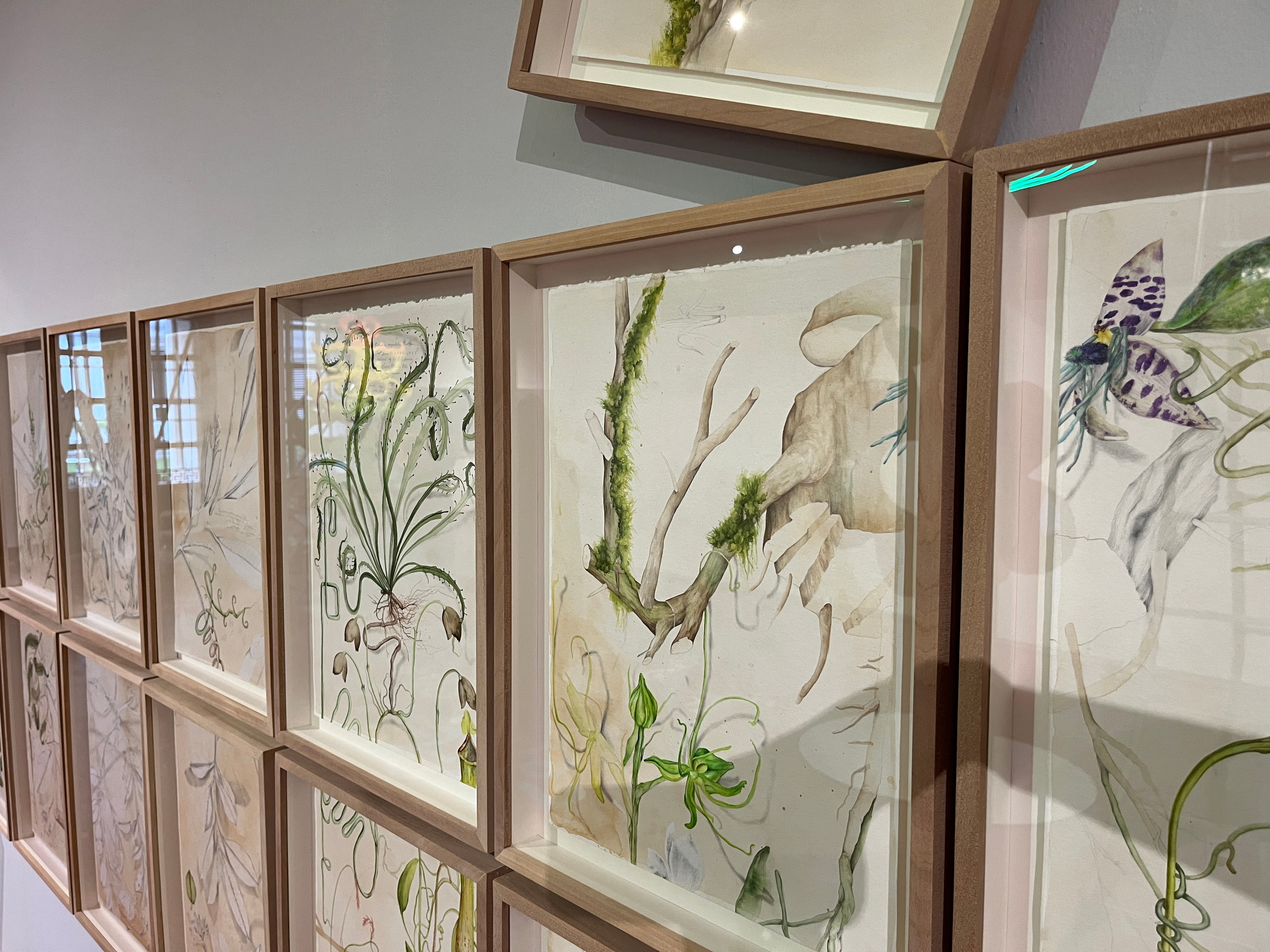
Liv Vinluan, Reckoning with Change, Watercolor, graphite, pencil and ink on bamboo paper, 2025
Reckoning with Change
Liv Vinluan’s watercolors are acts of fragility and remembrance. Returning to the nineteenth-century volume Flora de Filipinas, she reimagines its colonial botanical illustrations as hybrid forms—plants that are extinct, endangered, or conjured from fragments of memory. These works are not attempts at scientific precision, but elegies: records of what has been lost and what still haunts our ecological imagination.
Her choice of watercolor is deliberate. Long used by botanists for field study, the medium’s transparency and unpredictability embody the fleetingness of life. Each mark becomes a gesture of both taxonomy and entropy—an attempt to catalog, even as the form dissolves. For Vinluan, this fragility is not weakness but truth.
The installation presents these works at waist height, accompanied by magnifying lenses and notes resembling epitaphs or post-mortem reports. Viewers are invited to linger, to scrutinize, and to mourn. By framing her images as a “quiet resistance” and a “mourning archive,” Vinluan asks us to reckon with the violence of extinction, the colonial legacies of classification, and the inevitability of change.
Her watercolors remind us that beauty can exist in what fades, and that the act of noticing—slow, tender, attentive—is itself a radical gesture of care.
ACKNOWLEDGEMENTS
Curator
Mervy Pueblo
Thirteen Artists 2015
Jurors
Buen Calubayan
Thirteen Artists 2009
Antipas Delotavo
Thirteen Artists 1990
Wawi Navarroza
Thirteen Artists 2012
Rica Estrada Uson
CCP VAMD
Trophy Designer
Patricia Perez Eustaquio
Thirteen Artists 2009
CCP Visual Arts and Museum Division
Rica Estrada Uson
Officer-in-Charge
Czarina Caye Lopez
Senior Culture and Arts Officer
Charmaine Sibunga
Culture and Arts Officer III
Orlando Jarme Jr.
Culture and Arts Officer II
Angela Mistranza
Museum Associate,
Thirteen Artists Awards 2024 Project Coordinator
Janine Bernardo
Adonis Reuel Enciso
Collections Management Associates
Carla Patricia Yu
Exhibitions Associate
Merlin Arpon Jr.
Esteban Florendo Jr.
Art Installers
Our grateful appreciation for the assistance and support of
CCP Administrative Services Department
CCP General Services Division
CCP Maintenance and Engineering Services Division
CCP Marketing Department
CCP Motorpool
LSERV Corporation
Metrobank Foundation
National Museum of Fine Arts
Fine Arts Division
National Museum of Natural History
Botany and National Herbarium Division
Geology and Paleontology Division
Research, Collections and Conservation Management Division
Metrobank Foundation
Studio After Six
TORK Philippines Inc.
Sangkap Catering
Worn Expressions
And the entire team at the Cultural Center of the Philippines and the National Museum of the Philippines
Public Programs Schedule
Bodies, Myths, and Intimacies
11 October, Saturday, 2-4 PM
Curator’s Tour with
Mervy C. Pueblo
21 October, Tuesday, 2-4 PM
Identity, Memory, and Postcolonial Thought
8 November, Saturday, 2-4 PM
Materials in Flux: Process Form, and Movement
22 November, Saturday, 2-4 PM
Advocacy, Environment,
and Collective Survival
6 December, Saturday, 2-4 PM
Free admission, with limited seating
For inquiries, contact CCP Visual Arts and Museum Division

vamd@culturalcenter.gov.ph

8832-1125 loc 1504

CCP Visual Arts and Museum Division

ccpvamd

thirteenartists.culturalcenter.gov.ph
21am.culturalcenter.gov.ph

7 October 2025 –
12 January 2026
Sandiganbayan RECEPTION Hall, National Museum of Fine Arts
DISCLAIMER
The opinions, beliefs and viewpoints expressed by the artists on virtual or live performances, film, new media and exhibition do not state, reflect nor represent those of the Cultural Center of the Philippines’, its management, and its rank and file personnel.
There also exists no intention to malign any religion, ethnolinguistic group, organization, company or individual.

7 October 2025 – 12 January 2026
Sandiganbayan RECEPTION Hall, National Museum of Fine Arts
2024 Thirteen Artist Awardees
by Mervy Pueblo
The 2024 Thirteen Artists Awardees reveal a Philippine art that is awake, attentive, and insistently present. Across media and methods—video, sculpture, tapestry, watercolor, installation—they dwell in the spaces where memory, care, nature, and material converge, reflecting a generation that listens to the world with curiosity, care, and imagination.
Memory, History, and Identity threads through several practices. Joshua Serafin’s Cosmological Gangbang enacts precolonial, gender-diverse mythologies, reclaiming bodies and histories that the empire sought to erase. Russ Ligtas’ The Last Hapi layers diaspora, ritual, and historical trauma, inviting quiet reflection on what remains and what vanishes. Henrielle Baltazar Pagkaliwangan collects everyday objects into archives that resist closure, unsettle colonial taxonomies while tracing the porous lines of memory. Tekla Tamoria’s tapestry, What a Journey It Has Been, folds personal and collective journeys into stitched fragments of urban life, family, and faith, merging the intimate with the communal.
Care, Participation, and Relational Art emerges through objects and actions that accumulate meaning with audience involvement. Denver Garza’s participatory monument transforms keychains and paper tags into vessels of hope, weaving ritual and community care. Jel Suarez gathers domestic fragments into delicate “specimens” of attention, recording memory and tenderness in a quiet rhythm that asks viewers to pause, linger, and notice.
Nature, Ecology, and Transformation guides works that balance wonder with responsibility. Catalina Africa’s monumental sculptural landscapes evoke earth as teacher and portal, while Issay Rodriguez’s Star Eater, Soil Healer translates scientific observation into poetic acts of ecological stewardship. Liv Vinluan reimagines extinct and endangered flora, turning watercolor into elegiac gestures of attention, cataloging what fades while insisting on care.
The Poetics of Materials and the Everyday shape encounters with the ordinary, elevated through contemplation. Luis Antonio Santos’ Untitled (Structures) invites reflection on impermanence and liminality through galvanized iron sheets and subtle shifts of light and shadow. Ella Mendoza stages cognitive dissonance in forms that materialize tension and endurance. Vien Valencia traces displacement across streets and memory, using ephemeral marks to make legible the invisible labor of belonging.
Finally, visibility, absence, and social critique animate Derek Tumala’s Vanishing Tribe, which draws parallel lines between endangered species and vulnerable artists, reminding us that survival itself is a practice of attention, care, and ethical engagement.
Taken together, these thirteen artists do not merely reflect the world; they invent it, interrogate it, and inhabit it. They insist that Philippine art is capable of attentive listening, subtle wonder, and rigorous imagination. Their practices suggest a future that is experimental, relational, ecological, and profoundly human—a Philippine art attuned to local histories yet conversant with global concerns, finally catching up not by imitation, but through insistence, care, and vision.
ABOUT THE TAA
The Thirteen Artists Awards (TAA) started as a curatorial project of the Cultural Center of the Philippines (CCP) Museum under the directorship of its first curator Roberto Chabet in 1970.
The TAA was created in order to showcase the works of artists who grasped to “restructure, restrengthen and renew artmaking and art thinking…that lend viability to Philippine art”.
It was Raymundo Albano, the next Director of the CCP Museum and Non-theater Operations who transformed the TAA into the awards program that it is today. The TAA exhibition was mounted every two years from 1970 to 1980, and again in 1988, 1990, 1992 and 1994. It was revived in 2000, and changed to a triennial format, which it follows until today.
About the 2024 Thirteen Artists
The 2024 Thirteen Artists Awards program commenced upon the CCP Visual Arts and Museum Division’s (VAMD) public announcement of the call for nominations through print media, email, and social media, on 8 May 2024. A deadline of 9 July 2024 was given for the online submission of nominations. VAMD received eighty-two nomination forms from art groups, museum and gallery curators, directors, and art critics, forty-one of which were from former Thirteen Artists Awardees.
The jurors for the year were invited to be part of the 2024 Thirteen Artists Awards selection committee and were advised that he/she would not be able to submit a nomination given their role, and were reminded to keep their position as juror confidential until the formal announcement of awardees by the CCP.
The CCP VAMD gave all 119 nominated artists a deadline of 19 August 2024 for the submission of their digital portfolios. No hardcopy or printed portfolios were accepted. One artist declined their nomination, and ten chose not to submit their portfolio. A total of 108 portfolios were compiled by the CCP VAMD, for review by the selection committee.
The names of the 2024 Thirteen Artists Awardees were presented in a press conference at the CCP Tanghalang Ignacio Gimenez on
4 December 2024.
CATALINA AFRICA
Catalina Africa (b. 1988, Quezon City) considers shapeshifting and earth channeling to be her primary modes of expression.
She is a multidisciplinary artist who works in an array of mediums including painting, sound, sculpture, video, performance.
Her artworks are invocations to the natural landscape - they are spells, songs, love letters, prayers, maps, testimonies to the Earth’s mysteries and magic.
Africa lives and works in Aurora Province, Philippines with her husband and daughter, where she is currently cultivating a devotional practice to Spirit, transmuting Earth song, and continues to co-dream and collaborate with the living land. Africa is currently represented by Silverlens Gallery.
Catalina Africa, Earth Spirit Body Portals and Dreaming, PHANTOM, Printed chiffon, bamboo, 2025
Earth Spirit Body Portals and Dreaming
In this new sculptural installation, Catalina Africa transforms the gallery into a world where flowers tower over us, shadows harden into shrines, and raindrops shimmer as thresholds between earth and sky. Combining cement, resin, feathers, fabric, mirrors, and tarpaulin, she creates four human-scale figures anchored by a floor element shaped like roots or flames. Together, they form what she calls her “personal cosmology”—a landscape of spirits drawn from memory, meditation, and her sitio.
Africa’s work emerges from a long practice of painting landscapes that “speak back.” Here, she expands that dialogue into three dimensions, asking how the body feels awe in the presence of scale, light, and material contradiction. Flowers are no longer small and delicate but monumental; industrial cement carries water; synthetic glitter refracts natural light. These paradoxes embody the artist’s belief that nature is a teacher and that reconnecting with earth begins with wonder.
Rather than prescribing a narrative or ritual, Africa invites viewers to wander freely through the installation. Her aim is simple yet profound: to evoke feelings of magic, inspiration, and kilig. The installation is not a fixed story but a portal—a reminder that imagination can be an act of stewardship.
Denver Garza
Denver Garza (b. 1987, Manila) has an academic background in Psychology. Prior to pursuing art, he worked as a mental health worker.
His multidisciplinary practice ranges from painting, and mixed media crafts to participatory performances that contemplate the meaning and comfort in life and its uncertainties through the psyche and the psychosocial.
His works stem from intrapersonal dissection of identity, beliefs and social dynamics woven physically into a world through various media.
His exhibitions tackle various concerns and conditions such as the exploration of the self, family dynamics, internal transitions through resiliency. He attended an artist’s residency in Japan in 2018 and has conducted art therapy workshops in Manila. He currently resides in Bacoor, Cavite.
Denver Garza, Tagapagbitbit ng alinlangan, Custom key chain, various papers with thread, acrylic on stretched canvas and silkscreen, fiber filler, various crochet yarn, fabric and beads mounted on wooden structure, 2025
Tagapagbitbit ng alinlangan
Denver Garza’s installation invites us into an unfinished monument of care. Using stretched canvas, fabric, and an accumulation of everyday keychains, Garza creates a participatory sculpture that grows with the audience. Visitors are asked to contribute: to inscribe a burden on a red paper tag, to leave it behind, and to tie a keychain to the structure.
The form that emerges is not God, but a god—an imagined being that carries collective hope. Garza draws on memories of childhood devotionals, queer identity, and his past as a mental health worker, weaving ritual and therapy into a practice of communal release. The work resists the exclusivity of the art market by embracing the mass-produced keychain, transforming it into a vessel for personal reflection.
More than an object, the piece is an encounter. Each gesture—small, repetitive, and vulnerable—accumulates into a collective body. In this way, Garza’s work blurs the line between art and care, sculpture and ritual, personal memory and public offering. As Nicolas Bourriaud reminds us, art can operate as “a state of encounter,”¹ and Garza embraces this condition—where process, not permanence, becomes the ground of hope.
Russ Ligtas
Russ Ligtas (b. 1985, Cebu City), a multi-disciplinary artist and performer, spans over two decades of diverse creative work and various collaborations in Cebu, Manila, and beyond.
His solo art, including live performance, installation, sculpture, painting, choreography, and film, draws inspiration from various alter egos, serving as conduits for his explorations of the Filipino body as an expanding mythological matrix and a living historical, geopolitical, and anthropological artifact.
Photo courtesy of Dane Terry
Russ Ligtas, The Last Hapi, Video installation, Running time: 90 minutes, 2025
The Last Hapi
Russ Ligtas’ The Last Hapi is an exploration of identity, memory, and myth, framed as both a ritual and a self-portrait. Drawing from his experience as a Filipino navigating diaspora, Ligtas weaves together fragments of history, personal narrative, and cultural imagination to question what “Filipino-ness” might mean today.
The work unfolds as a hybrid: a film that is also a ritual, a performance that becomes an installation. At its center is stillness—an insistence on breath and silence in a world crowded with noise. The presence of a seated figure within the space, watching alongside the audience, transforms viewing into an act of reflection and mirroring.
By referencing 1972, the year Martial Law was declared in the Philippines, the piece gestures toward historical trauma while refusing to fix meaning. The Hapi’s disappearance may serve as metaphor, allegory, or simply myth. In this way, Ligtas leaves room for multiple readings—academic, political, or personal.
The installation space, envisioned as either a dark cinematic environment or an intimate living room, invites audiences into a porous bubble of contemplation. Here, Ligtas offers not answers, but a mirror: a chance to see ourselves in contradiction, and perhaps to find grace in the reflection.
Ella Mendoza
Ella Mendoza (b. 1993, Manila) started working with ceramics in 2015 while earning her BFA degrees in Painting (2014) and Art History (2017) at the University of the Philippines College of Fine Arts and has since been an active presence in the field.
Her practice in making functional wares in her early years later evolved into a play on contemporary counterparts of traditional vessels which later materialized in her conceptual, sculptural and installation work. She has held solo exhibitions with Artinformal Gallery and has participated in group exhibitions and art fairs in Manila and Bacolod, as well as in Singapore, Thailand, and Malaysia.
She has presented her work at the Australian Ceramics Congress, Art Fair Philippines 2022 Open Studios, and is a workshop presenter at The Ceramics School. She recently took part in the inaugural Maybank Foundation Artist Fellowship Program which was held in Bali, Indonesia last December 2023.
Ella Mendoza, Comfort of Contradiction, Stoneware, cotton rope, steel, terracotta bricks, 2025
Comfort of Contradiction
Ella Mendoza’s installation explores the psychology of cognitive dissonance—the tension of holding contradictory beliefs while refusing to reconcile them. Her forms evoke flesh, bone, and relic, yet never fully declare themselves. This ambiguity mirrors how societies absorb violence: through abstraction, compartmentalization, and silence.
At the center, a lamb on a clay brick plinth recalls religious sacrifice. But instead of redemption, it offers accusations. Around it, ropes descend in a triangulated array, suggesting both divine light and constriction. Chalk outlines trace absence like crime scenes, forcing the viewer to confront aftermath rather than spectacle.
Enclosed in graphite-gray walls, the space becomes a chamber of suspended judgment. Silence here is not neutral but charged, demanding that viewers notice their own reflexes of denial. Hal Foster’s discussion of abject and traumatic art shows how representation can fail not because of deficiency, but because it must reckon with the unassimilable.
Mendoza’s work does not offer answers. Instead, it stages the mechanisms by which we justify, compartmentalize, and live alongside violence—whether in faith, politics, or everyday life. In doing so, it asks us to reflect not on what violence is, but on how we manage to endure it.
Henrielle Baltazar Pagkaliwangan
Henrielle Baltazar Pagkaliwangan (b. 1994, Cavite) explores stories behind mundane yet indispensable objects to examine Philippine history and material culture. Drawing from natural history illustration and taxonomy, she documents personal and historical narratives through hand-pulled prints and drawings.
Pagkaliwangan graduated magna cum laude from the University of the Philippines Diliman, College of Fine Arts (Major in Studio Arts) in 2015, where she also received one of the Department of Studio Arts Outstanding Thesis Awards for her undergraduate thesis titled Taxonomy Of Things. In 2017, she won the grand prize in the Don Papa Rum Art Competition, which included a one-month residency in Florence, Italy. Her work has been exhibited in solo and group exhibitions in the Philippines, Indonesia, Korea, and Taiwan. She is pursuing a Master of Fine Arts degree at the University of the Philippines, where she also serves as a teaching associate.
Henrielle Baltazar Pagkaliwangan, Becoming, in Fragments, Graphite, and pen and ink, 2025
Becoming, in Fragments
Henrielle Baltazar Pagkaliwangan turns to the ordinary: spoons, jars, fabrics, brooms, coins. She gathers these into typologies that resemble catalogues and inventories, but instead of sealing objects into fixed meaning, she keeps them unsettled. A spoon beside a reliquary, a broom beside a colonial coin—the pairings resist hierarchy, suggesting another way of telling who we are.
Her installation takes the form of a long scroll, a surface that unfurls across the wall and table. Unlike framed prints, the scroll refuses finality. It behaves like memory—expansive, fragile, always being rewritten. Printmaking here is less about repetition than about variation; each impression registers a shift, a small rupture in the familiar.
Pagkaliwangan interrupts the canon of “Filipino motifs,” inserting anomalies and distortions that reveal how unstable history remains. The colonial gaze lingers in our taxonomies, yet her work redraws them into something more provisional, more alive.
Critic Hal Foster has described the “archival impulse” as the artist’s drive to reprogram fragments of the past into new forms. Pagkaliwangan follows this path with tenderness, creating an archive that breathes.
What she offers is not resolution but becoming—an identity still in sketch, still unfolding.
Issay Rodriguez
Issay Rodriguez (b. 1991) centers her current art practice on themes of humanism and ecology. Through archival research, community engagements, and interdisciplinary collaborations, she explores the articulation of thoughts, emotions, and values through art and technology.
She is an interdisciplinary artist, active member, and trustee for both the Philippine Botanical Art Society (PhilBAS) and the Philippine Native Plants Conservation Society Inc. (PNPCSI). She serves as the Assistant Director for the Healing and Regenerative Arts at Mahalina Foundation and lectures at the UP College of Fine Arts, Diliman. Her recent projects include solo exhibitions at Pintô Art Museum, Alliance Francaise de Manille, and workshops for the UP Vargas Museum, Fête De la Science in France, AVAT Taiwan, and Gasworks, London. She received the Benilde Open Design + Art Grant (2024), the Portfolio Art Prize (2020), and the Patnubay ng Sining at Kalinangan for Visual Arts (2017). She was also a finalist for the Fernando Zobel Visual Arts Prize (2018) and a UPCFA-Ecole Nationale Supérieure des Beaux-Arts Scholar, graduating with an Outstanding Thesis Award. In 2022, she represented the Philippines in the AFM-PARP Artist Residency in La Rochelle, France.
Issay Rodriguez, Cosmic Garden, collage of vegetable flowers photographed in UVIVF, 122 x 122 cm, 2022
Soil Eater Soil Healer
Star Eater, Soil Healer: Notes on Phytoremediation by Issay Rodriguez invites viewers into the hidden magic of plants and the regenerative possibilities of soil. Inspired by the rare Philippine species Rinorea niccolifera, which absorbs toxic nickel and restores ecosystems, Rodriguez transforms scientific observation into poetic visual narratives.
The exhibition’s study station includes drawings, cyanotypes, and motion graphics that reveal the plant’s capacity for transformation. Ambient whispers and soft poetry encourage reflection, curiosity, and slow engagement with the unseen processes of life beneath our feet. Visitors are invited to participate, linger, and form their own narratives about ecological resilience.
Rodriguez challenges conventional hierarchies of knowledge. Scientific documentation and artistic poetics coexist, and classification becomes a gesture of care rather than control. The exhibition fosters wonder, encouraging audiences to notice what is often overlooked and to participate in the quiet work of attention.
Star Eater, Soil Healer is a meditation on observation, care, and ecological responsibility. Through this work, Rodriguez shows that attending to the world, with curiosity and imagination, is an act of healing—both for the soil and for ourselves.
Luis Antonio Santos
Luis Antonio Santos (b. 1985, Quezon City) is a Quezon City-based visual artist whose work examines memory, entropy, isolation, and longing through painting and photography. Utilizing oil painting, printing, and image manipulation, he explores how recollections shift over time, employing everyday materials as metaphors for memory, space, and identity.
Exhibiting since 2010, Santos has held solo shows in Singapore (Fost Gallery) and Manila (Silverlens Gallery, West Gallery, Blanc, Finale Art File, MO_Space, Artinformal and the Drawing Room). He has participated in group exhibitions in Manila, New York (Jane Lombard Gallery), Beijing (Tang Contemporary), Singapore, Hong Kong, Athens, and Malaysia. He received the Fernando Zobel Prize and the Embassy of Italy Purchase Prize at the Ateneo Art Awards 2023, where he was previously shortlisted (2014, 2015). A finalist for the Sovereign Asian Art Prize 2023, he was also nominated for the Singapore Art Museum’s Signature Art Prize in 2018.
Luis Antonio Santos, Untitled (Structures), Oil on canvas/galvanised iron sheets mounted on stretcher (diptych), 2025
Untitled (Structures)
Untitled (Structures) pair iron sheets with their painted twins. Each groove, dent, and reflection carries time. Luis Antonio Santos captures the ordinary and lets it linger. Light shifts, shadows move, and the familiar becomes uncanny.
The diptych freezes an instant; the sheets continue to age, to reflect, to respond to the environment. The smaller Form/Void works isolate space and absence, inviting contemplation. Dim, quiet, almost altar-like, they draw attention to the unseen, the overlooked, the liminal.
Viewers are asked to look slowly, to notice subtle shifts. Boundaries between object and painting, form and void, past and present, blur. Everyday materials—the ubiquitous yero—become vessels for reflection, memory, and impermanence.
This exhibition encourages attention. Each encounter is unique. By noticing, we participate; by pausing, we inhabit space. Untitled (Structures) asks us to consider the quiet resonance of the familiar, the layered histories of material, and the delicate poetry of the everyday.
Joshua Serafin
Joshua Serafin (b. 1995, Bacolod City) is a multi-disciplinary artist who combines dance, performance, visual arts, and choreography. Born in the Philippines, they are currently based in Brussels. They are a house artist of Viernulvier for the season 2023-2027. Having graduated from the Philippine High School for the Arts where they majored in Theatre Arts, they moved on to major in contemporary dance at the Hong Kong Academy for Performing Arts. Joshua graduated from P.A.R.T.S. later on in 2019, and gained their Bachelors in Performance from KASK in 2021 where they also completed their Master’s in Fine Arts in Visual Arts in 2022 with great distinction.
Their Master’s work additionally earned them the Horliet-Dapsens Prij 2022,. They premiered their first solo work “Miss” in VIERNULVIER and have collaborated with multiple artists in Asia and Europe ranging from performance to visual arts. Their work has been shown internationally, most notably in, Esplanade, Singapore, BIT Teatergarasjen in Norway, Anti Festival in Finland , Nightshift in Ostende, Beursschowburg in Brussels, Tai Kwun Contemporary in Hong Kong, Haus Der Kulturen der Welt HKW, HAU Hebbel am Ufer in Berlin, and TONO Festival in Mexico.
They are also part of the Forbes list 30 under 30 Asia. They participate in the 60th International Art Exhibition of La Biennale di Venezia curated by Adriano Pedrosa. Their work VOID video installation, VOID live performance and PEARLS is part of “Foreigners Everywhere”.
Photo courtesy of Michiel Devijver
Joshua Serafin, VOID, live performance, 33 minutes, 30 seconds, 2024
Cosmological Gangbang
Bodies become stars, gods, memory.
In this three-part video installation, Joshua Serafin and collaborators reclaim what empire sought to erase: the sacred, shifting selves of precolonial gender-diverse identities in the Philippines.
Each screen offers a myth in motion:
PEARLS flows with ancestral femininity, a dance of song, liquid light, and ritual gesture. Creation Paradigm conjures celestial beings emerging from dark waters, a rebirth of deities for a new age.
VOID enacts a ritual of transformation, where body, spirit, and soil merge, creating a bridge between the earthly and the divine.
These works are acts of remembering, refusing erasure, and imagining futures. Collaborators’ movements expand, complicate, and queerness the narrative of identity and divinity. Sound, movement, and visual rhythm guide, disturb, and envelop the viewer, inviting reflection on the fluidity of time, spirit, and self.
Here, divinity is mutable. History is felt in flesh. Queer and trans bodies do not merely ask for space—they take it, beautifully, insistently, and undeniably.
Jel Suarez
Jel Suarez (b. 1990, Quezon City) is a self-taught visual artist currently based in Bacolod City. She graduated with a BS in Psychology from the University of Santo Tomas (2011), and has completed courses towards an MA in Special Education through an academic scholarship from De La Salle University (2015). In 2014, she began exhibiting her works with various galleries, while holding a profession as a childhood educator.
Suarez worked on her artist practice full-time after her Southeast Asian residency at Rimbun Dahan in Malaysia (2017). Her solo exhibitions with West Gallery (2018 and 2020), and MO_Space Gallery (2019) were consecutively shortlisted for the Ateneo Art Awards, where she became the first recipient of its Italian Embassy’s Purchase Prize.
Suarez collaborated with contemporary artists and artist spaces in creating workshops for children through the Ateneo Art Gallery’s educational programs (2018-2021). She was a finalist for the Sovereign Asian Art Prize in Hong Kong (2022), and was recently an artist-in-residence at the Leipzig International Art Programme in Germany through the Goethe-Institut (2023-2024).
Jel Suarez, Specimens, Acrylic display shelf, acrylic components, image projection, 2025
Specimens
Jel Suarez’s cutouts gather quietly along the wall, each a fragment of life suspended in clear acrylic. She calls them “specimens,” though they are neither scientific nor cold—they are small records of care, memory, and attention. Born from her mother’s illness, childhood experiences of labeling objects in her grandmother’s pawnshop, and years of collecting fragments from books and collages, these works transform the ordinary into something intimate and resonant.
The acrylic catches light and shadow, folds and overlaps, creating layers that both conceal and reveal. Each piece invites careful looking, a pause, a moment of reflection. Arranged in a grid, the fragments create a rhythm that comforts while leaving space for wandering, for discovery. There is no single story here—only traces, whispers, echoes of domestic labor, archival practice, and acts of care, preserved in material form.
Suarez’s specimens ask us to notice the small gestures: the cut, the fold, the layering of fragments. Ordinary materials, when attended to with tenderness, carry weight and meaning. In this quiet insistence, we find intimacy, resilience, and memory made visible—a meditation on how the fragments of our lives, carefully observed, can speak to the universal.
Tekla Tamoria
Ma. Athela "Tekla" Tamoria (b. 1989, Quezon City) graduated with a degree in Painting from the University of the Philippines College of Fine Arts in 2010. After two years of working in the corporate sector, she pursued tailoring at a local technical school allowing her to further her practice of working with textiles. She has completed residencies at the Beppu Project in Japan (2023) and at ABungalow in Talisay (2024).
Tamoria has been a featured artist in art fairs such as Art in the Park 2018 and at the Asia Now Paris Art Fair in 2018 by representation of Vinyl on Vinyl. She had works included in two museum exhibitions: More than a Hat at the Metropolitan Museum of Manila (2022) and Variation of the Fields at Vargas Museum (December 2019). In 2023, Tamoria was one of the Ateneo Art Awards (AAA) Fernando Zóbel Prizes for Visual Art winners with an upcoming residency at NoSpace in Baguio.
Tekla Tamoria, Sa may kanto nagkakape, tapestry, 97.7 x 90.1 cm, 2020
What a Journey It Has Been
A tapestry thirty feet long unfolds like a diary stitched in cloth. Using recycled fabric, beadwork, and quilting techniques, Tekla Tamoria weaves together three overlapping journeys: her passage from childhood to adulthood, her daily experience as a commuter along EDSA, and her path to becoming an artist.
The work is both personal and collective. Landmarks, religious symbols, vehicles, and fragments of family life appear across the textile, echoing the textures of urban survival and middle-class Filipino identity. Its title — borrowed from a Lea Salonga ballad — sets the tone: tender, humorous, and resilient. Humor, for Tamoria, is a deliberate strategy, a way of observing life’s challenges while transforming them into something we can hold.
Fabric is Tamoria’s natural medium. Inspired by her grandmother, a dressmaker, and further trained in dressmaking herself, she treats sewing as both skill and storytelling. The tactile richness of her beadwork and stitched details speaks of time, patience, and intimacy.
While deeply self-referential — a visual self-portrait in fragments — the tapestry also gestures outward. In honoring jeepneys, faith, and everyday struggles, Tamoria’s journey becomes ours: a shared fabric of memory, mobility, and becoming.
Derek Tumala
Derek Tumala (b. 1986, Manila) is a visual artist staging various media and subjects in the pursuit of ecological world-making. Tumala’s wide-ranging scope of practice explores the possibilities of art in the form of knowledge, schematics, living systems, object orientation, moving image, emerging technologies, staged performance or public program.
His art practice revolves around the realms of science and nature meditating on the idea of interconnectedness. By forming ecologies and systems of thought, Tumala’s practice traces mutuality between human and its changing natural and built environments.
Tumala’s diverse art practice has led him to present projects at the Museum of Contemporary Art & Design-Manila, World Weather Network, Jogjakarta Biennale, International Rice Research Institute, Manila Observatory, Delfina Foundation, UK, Sainsbury Centre, UK, Art Basel Hong Kong and more. In 2024, Tumala was named one of ArtReview Magazine’s Future Greats.
Photo courtesy of Geric Cruz
Derek Tumala, Kayamanan ng Pilipinas (Treasures of the Philippines), LED wall, video, color, Javascript codes, CPU, Climacell Weather API, 10 x 6 m, 2021-2022
Vanishing Tribe
Some disappearances are loud—broadcast, mourned, historicized. Others happen slowly, almost silently. Vanishing Tribe draws attention to the quiet violence of erasure.
In this work, Derek Tumala places side by side two vulnerable forms of life: endangered species and artists—queer, women-identifying, Filipino. The two-channel video alternates between taxidermied animals inside the National Museum of Natural History and portraits of living artists who, like those animals, survive within systems that threaten their existence.
It is not a simple metaphor. The parallel is material, embodied. What connects these vanishing lives are the legacies of colonialism, environmental collapse, hypercapitalism, and policies that privilege profit over life. The extinction of animals and the precarity of artists are not isolated tragedies; they are symptoms of the same world order.
Tumala does not offer spectacle—he offers pause. A space to reflect on who gets archived and who gets forgotten. Who is protected by institutions, and who is left to fend for themselves.The act of gathering, making visible, insisting on presence, becomes a quiet protest.
Pay attention. What vanishes does not always return.
Vien Valencia
Vien Valencia (b. 1998, Quezon City) situates his work at the intersection of community, time, site, process, and anthropology. In 2023, he won the Ateneo Art Award for your age, my age, and the age of the river, a collaboration with the Dumagat-Remontado indigenous group facing a grave threat to their way of life due to a dam construction that will submerge their river, villages, and livelihoods.
Singapore Art Museum commissioned Valencia’s imprint of an imprint of an imprint, an extension of the artist’s developing research into the Tinipak River in Tanay, Rizal and Quezon Province, Philippines, and its surrounding communities. He works on alternative archive projects, tied together by an interest in challenging traditional methods of archiving, such as the gradual sinking of barangays in Bulacan and the Badjao group’s exodus from Mindanao to Manila.
Vien Valencia, Long Drawing, Single-channel video installation, Running time: 3 hours, 33 minutes, 47 seconds, 2025
Long Drawing
Vien Valencia’s Long Drawing begins with a simple act: chalk and/or crayon pressed to the ground, feet moving forward, a line left behind. Yet this mark is more than a drawing—it is a record of displacement.
As a child, Valencia notices that his school ID’s carry a new address. His family moved constantly, pushed by eviction and survival. What seemed temporary became a cycle of uprooting. Chalk and crayon, like memory, is fragile: it can be erased, smudged, paved over. Still, each line carries the weight of a journey, of bodies in search of permanence.
Unlike traditional drawings on pristine paper, Valencia chooses the streets—overlooked, burdened, humble—as his picture plane. To draw his path from current home to previous, honor the movement itself, to trace an archive of survival across city streets.
The imagined distances and connections of Long Drawing would exceed any gallery wall. What you encounter here is a video installation that gestures toward the impossible scale of displacement. Valencia’s work is not about nostalgia but about grounding—asking what it means to belong when belonging is always at risk.
Liv Vinluan
Liv Vinluan (b. 1987, Manila) graduated from the College of Fine Arts at the University of the Philippines in Diliman and has been exhibiting her work for the past sixteen years. History remains as the singular, defining cornerstone of her work.
Now 37, she continues her investigations on death and mortality, the cyclicality of histories, the inconsistencies of human character and behavior, and the passage of time. She lives and works in the hills of Antipolo, Rizal.
Liv Vinluan, Reckoning with Change, Watercolor, graphite, pencil and ink on bamboo paper, 2025
Reckoning with Change
Liv Vinluan’s watercolors are acts of fragility and remembrance. Returning to the nineteenth-century volume Flora de Filipinas, she reimagines its colonial botanical illustrations as hybrid forms—plants that are extinct, endangered, or conjured from fragments of memory. These works are not attempts at scientific precision, but elegies: records of what has been lost and what still haunts our ecological imagination.
Her choice of watercolor is deliberate. Long used by botanists for field study, the medium’s transparency and unpredictability embody the fleetingness of life. Each mark becomes a gesture of both taxonomy and entropy—an attempt to catalog, even as the form dissolves. For Vinluan, this fragility is not weakness but truth.
The installation presents these works at waist height, accompanied by magnifying lenses and notes resembling epitaphs or post-mortem reports. Viewers are invited to linger, to scrutinize, and to mourn. By framing her images as a “quiet resistance” and a “mourning archive,” Vinluan asks us to reckon with the violence of extinction, the colonial legacies of classification, and the inevitability of change.
Her watercolors remind us that beauty can exist in what fades, and that the act of noticing—slow, tender, attentive—is itself a radical gesture of care.
ACKNOWLEDGEMENTS
Curator
Mervy Pueblo
Thirteen Artists 2015
Jurors
Buen Calubayan
Thirteen Artists 2009
Antipas Delotavo
Thirteen Artists 1990
Wawi Navarroza
Thirteen Artists 2012
Phyllis Zaballero
Thirteen Artists 1978
Rica Estrada Uson
CCP VAMD
Trophy Designer
Patricia Perez Eustaquio
Thirteen Artists 2009
CCP Visual Arts and Museum Division
Rica Estrada Uson
Officer-in-Charge
Czarina Caye Lopez
Senior Culture and Arts Officer
Charmaine Sibunga
Culture and Arts Officer III
Orlando Jarme Jr.
Culture and Arts Officer II
Angela Mistranza
Museum Associate,
Thirteen Artists Awards 2024 Project Coordinator
Janine Bernardo
Adonis Reuel Enciso
Collections Management Associates
Carla Patricia Yu
Exhibitions Associate
Merlin Arpon Jr.
Esteban Florendo Jr.
Art Installers
Our grateful appreciation for the assistance and support of
CCP Administrative Services Department
CCP General Services Division
CCP Maintenance and Engineering Services Division
CCP Marketing Department
CCP Motorpool
LSERV Corporation
Metrobank Foundation
National Museum of Fine Arts
Fine Arts Division
National Museum of Natural History
Botany and National Herbarium Division
Geology and Paleontology Division
Research, Collections and Conservation Management Division
Metrobank Foundation
Studio After Six
TORK Philippines Inc.
Sangkap Catering
Worn Expressions
And the entire team at the Cultural Center of the Philippines and the National Museum of the Philippines
Public Programs Schedule
Bodies, Myths, and Intimacies
11 October, Saturday, 2-4 PM
Curator’s Tour with
Mervy C. Pueblo
21 October, Tuesday, 2-4 PM
Identity, Memory, and Postcolonial Thought
8 November, Saturday, 2-4 PM
Materials in Flux: Process Form, and Movement
22 November, Saturday, 2-4 PM
Advocacy, Environment,
and Collective Survival
6 December, Saturday, 2-4 PM
Free admission, with limited seating
For inquiries, contact CCP Visual Arts and Museum Division
vamd@culturalcenter.gov.ph
8832-1125 loc 1504
CCP Visual Arts and Museum Division
ccpvamd
thirteenartists.culturalcenter.gov.ph
21am.culturalcenter.gov.ph

7 October 2025 –
12 January 2026
Sandiganbayan RECEPTION Hall, National Museum of Fine Arts
DISCLAIMER
The opinions, beliefs and viewpoints expressed by the artists on virtual or live performances, film, new media and exhibition do not state, reflect nor represent those of the Cultural Center of the Philippines’, its management, and its rank and file personnel.
There also exists no intention to malign any religion, ethnolinguistic group, organization, company or individual.

7 October 2025 – 12 January 2026
Sandiganbayan RECEPTION Hall, National Museum of Fine Arts
2024 Thirteen Artist Awardees
by Mervy Pueblo
The 2024 Thirteen Artists Awardees reveal a Philippine art that is awake, attentive, and insistently present. Across media and methods—video, sculpture, tapestry, watercolor, installation—they dwell in the spaces where memory, care, nature, and material converge, reflecting a generation that listens to the world with curiosity, care, and imagination.
Memory, History, and Identity threads through several practices. Joshua Serafin’s Cosmological Gangbang enacts precolonial, gender-diverse mythologies, reclaiming bodies and histories that the empire sought to erase. Russ Ligtas’ The Last Hapi layers diaspora, ritual, and historical trauma, inviting quiet reflection on what remains and what vanishes. Henrielle Baltazar Pagkaliwangan collects everyday objects into archives that resist closure, unsettle colonial taxonomies while tracing the porous lines of memory. Tekla Tamoria’s tapestry, What a Journey It Has Been, folds personal and collective journeys into stitched fragments of urban life, family, and faith, merging the intimate with the communal.
Care, Participation, and Relational Art emerges through objects and actions that accumulate meaning with audience involvement. Denver Garza’s participatory monument transforms keychains and paper tags into vessels of hope, weaving ritual and community care. Jel Suarez gathers domestic fragments into delicate “specimens” of attention, recording memory and tenderness in a quiet rhythm that asks viewers to pause, linger, and notice.
Nature, Ecology, and Transformation guides works that balance wonder with responsibility. Catalina Africa’s monumental sculptural landscapes evoke earth as teacher and portal, while Issay Rodriguez’s Star Eater, Soil Healer translates scientific observation into poetic acts of ecological stewardship. Liv Vinluan reimagines extinct and endangered flora, turning watercolor into elegiac gestures of attention, cataloging what fades while insisting on care.
The Poetics of Materials and the Everyday shape encounters with the ordinary, elevated through contemplation. Luis Antonio Santos’ Untitled (Structures) invites reflection on impermanence and liminality through galvanized iron sheets and subtle shifts of light and shadow. Ella Mendoza stages cognitive dissonance in forms that materialize tension and endurance. Vien Valencia traces displacement across streets and memory, using ephemeral marks to make legible the invisible labor of belonging.
Finally, visibility, absence, and social critique animate Derek Tumala’s Vanishing Tribe, which draws parallel lines between endangered species and vulnerable artists, reminding us that survival itself is a practice of attention, care, and ethical engagement.
Taken together, these thirteen artists do not merely reflect the world; they invent it, interrogate it, and inhabit it. They insist that Philippine art is capable of attentive listening, subtle wonder, and rigorous imagination. Their practices suggest a future that is experimental, relational, ecological, and profoundly human—a Philippine art attuned to local histories yet conversant with global concerns, finally catching up not by imitation, but through insistence, care, and vision.
ABOUT THE TAA
The Thirteen Artists Awards (TAA) started as a curatorial project of the Cultural Center of the Philippines (CCP) Museum under the directorship of its first curator Roberto Chabet in 1970.
The TAA was created in order to showcase the works of artists who grasped to “restructure, restrengthen and renew artmaking and art thinking…that lend viability to Philippine art”.
It was Raymundo Albano, the next Director of the CCP Museum and Non-theater Operations who transformed the TAA into the awards program that it is today. The TAA exhibition was mounted every two years from 1970 to 1980, and again in 1988, 1990, 1992 and 1994. It was revived in 2000, and changed to a triennial format, which it follows until today.
About the 2024 Thirteen Artists
The 2024 Thirteen Artists Awards program commenced upon the CCP Visual Arts and Museum Division’s (VAMD) public announcement of the call for nominations through print media, email, and social media, on 8 May 2024. A deadline of 9 July 2024 was given for the online submission of nominations. VAMD received eighty-two nomination forms from art groups, museum and gallery curators, directors, and art critics, forty-one of which were from former Thirteen Artists Awardees.
The jurors for the year were invited to be part of the 2024 Thirteen Artists Awards selection committee and were advised that he/she would not be able to submit a nomination given their role, and were reminded to keep their position as juror confidential until the formal announcement of awardees by the CCP. The jurors for 2024 were Buen Calubayan, Antipas Delotavo, Wawi Navarroza, Phyllis Zaballero, and Rica Estrada Uson from the CCP VAMD.
The CCP VAMD gave all 119 nominated artists a deadline of 19 August 2024 for the submission of their digital portfolios. No hardcopy or printed portfolios were accepted. One artist declined their nomination, and ten chose not to submit their portfolio. A total of 108 portfolios were compiled by the CCP VAMD, for review by the selection committee.
The names of the 2024 Thirteen Artists Awardees were presented in a press conference at the CCP Tanghalang Ignacio Gimenez on 4 December 2024.
CATALINA AFRICA
Catalina Africa (b. 1988, Quezon City) considers shapeshifting and earth channeling to be her primary modes of expression.
She is a multidisciplinary artist who works in an array of mediums including painting, sound, sculpture, video, performance.
Her artworks are invocations to the natural landscape - they are spells, songs, love letters, prayers, maps, testimonies to the Earth’s mysteries and magic.
Africa lives and works in Aurora Province, Philippines with her husband and daughter, where she is currently cultivating a devotional practice to Spirit, transmuting Earth song, and continues to co-dream and collaborate with the living land. Africa is currently represented by Silverlens Gallery.
Catalina Africa, Earth Spirit Body Portals and Dreaming, PHANTOM, Printed chiffon, bamboo, 2025
Earth Spirit Body Portals and Dreaming
In this new sculptural installation, Catalina Africa transforms the gallery into a world where flowers tower over us, shadows harden into shrines, and raindrops shimmer as thresholds between earth and sky. Combining cement, resin, feathers, fabric, mirrors, and tarpaulin, she creates four human-scale figures anchored by a floor element shaped like roots or flames. Together, they form what she calls her “personal cosmology”—a landscape of spirits drawn from memory, meditation, and her sitio.
Africa’s work emerges from a long practice of painting landscapes that “speak back.” Here, she expands that dialogue into three dimensions, asking how the body feels awe in the presence of scale, light, and material contradiction. Flowers are no longer small and delicate but monumental; industrial cement carries water; synthetic glitter refracts natural light. These paradoxes embody the artist’s belief that nature is a teacher and that reconnecting with earth begins with wonder.
Rather than prescribing a narrative or ritual, Africa invites viewers to wander freely through the installation. Her aim is simple yet profound: to evoke feelings of magic, inspiration, and kilig. The installation is not a fixed story but a portal—a reminder that imagination can be an act of stewardship.
Denver Garza
Denver Garza (b. 1987, Manila) has an academic background in Psychology. Prior to pursuing art, he worked as a mental health worker.
His multidisciplinary practice ranges from painting, and mixed media crafts to participatory performances that contemplate the meaning and comfort in life and its uncertainties through the psyche and the psychosocial.
His works stem from intrapersonal dissection of identity, beliefs and social dynamics woven physically into a world through various media.
His exhibitions tackle various concerns and conditions such as the exploration of the self, family dynamics, internal transitions through resiliency. He attended an artist’s residency in Japan in 2018 and has conducted art therapy workshops in Manila. He currently resides in Bacoor, Cavite.
Denver Garza, Tagapagbitbit ng alinlangan, Custom key chain, various papers with thread, acrylic on stretched canvas and silkscreen, fiber filler, various crochet yarn, fabric and beads mounted on wooden structure, 2025
Tagapagbitbit ng alinlangan
Denver Garza’s installation invites us into an unfinished monument of care. Using stretched canvas, fabric, and an accumulation of everyday keychains, Garza creates a participatory sculpture that grows with the audience. Visitors are asked to contribute: to inscribe a burden on a red paper tag, to leave it behind, and to tie a keychain to the structure.
The form that emerges is not God, but a god—an imagined being that carries collective hope. Garza draws on memories of childhood devotionals, queer identity, and his past as a mental health worker, weaving ritual and therapy into a practice of communal release. The work resists the exclusivity of the art market by embracing the mass-produced keychain, transforming it into a vessel for personal reflection.
More than an object, the piece is an encounter. Each gesture—small, repetitive, and vulnerable—accumulates into a collective body. In this way, Garza’s work blurs the line between art and care, sculpture and ritual, personal memory and public offering. As Nicolas Bourriaud reminds us, art can operate as “a state of encounter,”¹ and Garza embraces this condition—where process, not permanence, becomes the ground of hope.
Russ Ligtas
Russ Ligtas (b. 1985, Cebu City), a multi-disciplinary artist and performer, spans over two decades of diverse creative work and various collaborations in Cebu, Manila, and beyond.
His solo art, including live performance, installation, sculpture, painting, choreography, and film, draws inspiration from various alter egos, serving as conduits for his explorations of the Filipino body as an expanding mythological matrix and a living historical, geopolitical, and anthropological artifact.
Photo courtesy of Dane Terry
Russ Ligtas, The Last Hapi, Video installation, Running time: 90 minutes, 2025
The Last Hapi
Russ Ligtas’ The Last Hapi is an exploration of identity, memory, and myth, framed as both a ritual and a self-portrait. Drawing from his experience as a Filipino navigating diaspora, Ligtas weaves together fragments of history, personal narrative, and cultural imagination to question what “Filipino-ness” might mean today.
The work unfolds as a hybrid: a film that is also a ritual, a performance that becomes an installation. At its center is stillness—an insistence on breath and silence in a world crowded with noise. The presence of a seated figure within the space, watching alongside the audience, transforms viewing into an act of reflection and mirroring.
By referencing 1972, the year Martial Law was declared in the Philippines, the piece gestures toward historical trauma while refusing to fix meaning. The Hapi’s disappearance may serve as metaphor, allegory, or simply myth. In this way, Ligtas leaves room for multiple readings—academic, political, or personal.
The installation space, envisioned as either a dark cinematic environment or an intimate living room, invites audiences into a porous bubble of contemplation. Here, Ligtas offers not answers, but a mirror: a chance to see ourselves in contradiction, and perhaps to find grace in the reflection.
Ella Mendoza
Ella Mendoza (b. 1993, Manila) started working with ceramics in 2015 while earning her BFA degrees in Painting (2014) and Art History (2017) at the University of the Philippines College of Fine Arts and has since been an active presence in the field.
Her practice in making functional wares in her early years later evolved into a play on contemporary counterparts of traditional vessels which later materialized in her conceptual, sculptural and installation work. She has held solo exhibitions with Artinformal Gallery and has participated in group exhibitions and art fairs in Manila and Bacolod, as well as in Singapore, Thailand, and Malaysia.
She has presented her work at the Australian Ceramics Congress, Art Fair Philippines 2022 Open Studios, and is a workshop presenter at The Ceramics School. She recently took part in the inaugural Maybank Foundation Artist Fellowship Program which was held in Bali, Indonesia last December 2023.
Ella Mendoza, Comfort of Contradiction, Stoneware, cotton rope, steel, terracotta bricks, 2025
Comfort of Contradiction
Ella Mendoza’s installation explores the psychology of cognitive dissonance—the tension of holding contradictory beliefs while refusing to reconcile them. Her forms evoke flesh, bone, and relic, yet never fully declare themselves. This ambiguity mirrors how societies absorb violence: through abstraction, compartmentalization, and silence.
At the center, a lamb on a clay brick plinth recalls religious sacrifice. But instead of redemption, it offers accusations. Around it, ropes descend in a triangulated array, suggesting both divine light and constriction. Chalk outlines trace absence like crime scenes, forcing the viewer to confront aftermath rather than spectacle.
Enclosed in graphite-gray walls, the space becomes a chamber of suspended judgment. Silence here is not neutral but charged, demanding that viewers notice their own reflexes of denial. Hal Foster’s discussion of abject and traumatic art shows how representation can fail not because of deficiency, but because it must reckon with the unassimilable.
Mendoza’s work does not offer answers. Instead, it stages the mechanisms by which we justify, compartmentalize, and live alongside violence—whether in faith, politics, or everyday life. In doing so, it asks us to reflect not on what violence is, but on how we manage to endure it.
Henrielle Baltazar Pagkaliwangan
Henrielle Baltazar Pagkaliwangan (b. 1994, Cavite) explores stories behind mundane yet indispensable objects to examine Philippine history and material culture. Drawing from natural history illustration and taxonomy, she documents personal and historical narratives through hand-pulled prints and drawings.
Pagkaliwangan graduated magna cum laude from the University of the Philippines Diliman, College of Fine Arts (Major in Studio Arts) in 2015, where she also received one of the Department of Studio Arts Outstanding Thesis Awards for her undergraduate thesis titled Taxonomy Of Things. In 2017, she won the grand prize in the Don Papa Rum Art Competition, which included a one-month residency in Florence, Italy. Her work has been exhibited in solo and group exhibitions in the Philippines, Indonesia, Korea, and Taiwan. She is pursuing a Master of Fine Arts degree at the University of the Philippines, where she also serves as a teaching associate.
Henrielle Baltazar Pagkaliwangan, Becoming, in Fragments, Graphite, and pen and ink, 2025
Becoming, in Fragments
Henrielle Baltazar Pagkaliwangan turns to the ordinary: spoons, jars, fabrics, brooms, coins. She gathers these into typologies that resemble catalogues and inventories, but instead of sealing objects into fixed meaning, she keeps them unsettled. A spoon beside a reliquary, a broom beside a colonial coin—the pairings resist hierarchy, suggesting another way of telling who we are.
Her installation takes the form of a long scroll, a surface that unfurls across the wall and table. Unlike framed prints, the scroll refuses finality. It behaves like memory—expansive, fragile, always being rewritten. Printmaking here is less about repetition than about variation; each impression registers a shift, a small rupture in the familiar.
Pagkaliwangan interrupts the canon of “Filipino motifs,” inserting anomalies and distortions that reveal how unstable history remains. The colonial gaze lingers in our taxonomies, yet her work redraws them into something more provisional, more alive.
Critic Hal Foster has described the “archival impulse” as the artist’s drive to reprogram fragments of the past into new forms. Pagkaliwangan follows this path with tenderness, creating an archive that breathes.
What she offers is not resolution but becoming—an identity still in sketch, still unfolding.
Issay Rodriguez
Issay Rodriguez (b. 1991) centers her current art practice on themes of humanism and ecology. Through archival research, community engagements, and interdisciplinary collaborations, she explores the articulation of thoughts, emotions, and values through art and technology.
She is an interdisciplinary artist, active member, and trustee for both the Philippine Botanical Art Society (PhilBAS) and the Philippine Native Plants Conservation Society Inc. (PNPCSI). She serves as the Assistant Director for the Healing and Regenerative Arts at Mahalina Foundation and lectures at the UP College of Fine Arts, Diliman. Her recent projects include solo exhibitions at Pintô Art Museum, Alliance Francaise de Manille, and workshops for the UP Vargas Museum, Fête De la Science in France, AVAT Taiwan, and Gasworks, London. She received the Benilde Open Design + Art Grant (2024), the Portfolio Art Prize (2020), and the Patnubay ng Sining at Kalinangan for Visual Arts (2017). She was also a finalist for the Fernando Zobel Visual Arts Prize (2018) and a UPCFA-Ecole Nationale Supérieure des Beaux-Arts Scholar, graduating with an Outstanding Thesis Award. In 2022, she represented the Philippines in the AFM-PARP Artist Residency in La Rochelle, France.
Issay Rodriguez, Cosmic Garden, collage of vegetable flowers photographed in UVIVF, 122 x 122 cm, 2022
Soil Eater Soil Healer
Star Eater, Soil Healer: Notes on Phytoremediation by Issay Rodriguez invites viewers into the hidden magic of plants and the regenerative possibilities of soil. Inspired by the rare Philippine species Rinorea niccolifera, which absorbs toxic nickel and restores ecosystems, Rodriguez transforms scientific observation into poetic visual narratives.
The exhibition’s study station includes drawings, cyanotypes, and motion graphics that reveal the plant’s capacity for transformation. Ambient whispers and soft poetry encourage reflection, curiosity, and slow engagement with the unseen processes of life beneath our feet. Visitors are invited to participate, linger, and form their own narratives about ecological resilience.
Rodriguez challenges conventional hierarchies of knowledge. Scientific documentation and artistic poetics coexist, and classification becomes a gesture of care rather than control. The exhibition fosters wonder, encouraging audiences to notice what is often overlooked and to participate in the quiet work of attention.
Star Eater, Soil Healer is a meditation on observation, care, and ecological responsibility. Through this work, Rodriguez shows that attending to the world, with curiosity and imagination, is an act of healing—both for the soil and for ourselves.
Luis Antonio Santos
Luis Antonio Santos (b. 1985, Quezon City) is a Quezon City-based visual artist whose work examines memory, entropy, isolation, and longing through painting and photography. Utilizing oil painting, printing, and image manipulation, he explores how recollections shift over time, employing everyday materials as metaphors for memory, space, and identity.
Exhibiting since 2010, Santos has held solo shows in Singapore (Fost Gallery) and Manila (Silverlens Gallery, West Gallery, Blanc, Finale Art File, MO_Space, Artinformal and the Drawing Room). He has participated in group exhibitions in Manila, New York (Jane Lombard Gallery), Beijing (Tang Contemporary), Singapore, Hong Kong, Athens, and Malaysia. He received the Fernando Zobel Prize and the Embassy of Italy Purchase Prize at the Ateneo Art Awards 2023, where he was previously shortlisted (2014, 2015). A finalist for the Sovereign Asian Art Prize 2023, he was also nominated for the Singapore Art Museum’s Signature Art Prize in 2018.
Luis Antonio Santos, Untitled (Structures), Oil on canvas/galvanised iron sheets mounted on stretcher (diptych), 2025
Untitled (Structures)
Untitled (Structures) pair iron sheets with their painted twins. Each groove, dent, and reflection carries time. Luis Antonio Santos captures the ordinary and lets it linger. Light shifts, shadows move, and the familiar becomes uncanny.
The diptych freezes an instant; the sheets continue to age, to reflect, to respond to the environment. The smaller Form/Void works isolate space and absence, inviting contemplation. Dim, quiet, almost altar-like, they draw attention to the unseen, the overlooked, the liminal.
Viewers are asked to look slowly, to notice subtle shifts. Boundaries between object and painting, form and void, past and present, blur. Everyday materials—the ubiquitous yero—become vessels for reflection, memory, and impermanence.
This exhibition encourages attention. Each encounter is unique. By noticing, we participate; by pausing, we inhabit space. Untitled (Structures) asks us to consider the quiet resonance of the familiar, the layered histories of material, and the delicate poetry of the everyday.
Joshua Serafin
Joshua Serafin (b. 1995, Bacolod City) is a multi-disciplinary artist who combines dance, performance, visual arts, and choreography. Born in the Philippines, they are currently based in Brussels. They are a house artist of Viernulvier for the season 2023-2027. Having graduated from the Philippine High School for the Arts where they majored in Theatre Arts, they moved on to major in contemporary dance at the Hong Kong Academy for Performing Arts. Joshua graduated from P.A.R.T.S. later on in 2019, and gained their Bachelors in Performance from KASK in 2021 where they also completed their Master’s in Fine Arts in Visual Arts in 2022 with great distinction.
Their Master’s work additionally earned them the Horliet-Dapsens Prij 2022,. They premiered their first solo work “Miss” in VIERNULVIER and have collaborated with multiple artists in Asia and Europe ranging from performance to visual arts. Their work has been shown internationally, most notably in, Esplanade, Singapore, BIT Teatergarasjen in Norway, Anti Festival in Finland , Nightshift in Ostende, Beursschowburg in Brussels, Tai Kwun Contemporary in Hong Kong, Haus Der Kulturen der Welt HKW, HAU Hebbel am Ufer in Berlin, and TONO Festival in Mexico.
They are also part of the Forbes list 30 under 30 Asia. They participate in the 60th International Art Exhibition of La Biennale di Venezia curated by Adriano Pedrosa. Their work VOID video installation, VOID live performance and PEARLS is part of “Foreigners Everywhere”.
Photo courtesy of Michiel Devijver
Joshua Serafin, VOID, live performance, 33 minutes, 30 seconds, 2024
Cosmological Gangbang
Bodies become stars, gods, memory.
In this three-part video installation, Joshua Serafin and collaborators reclaim what empire sought to erase: the sacred, shifting selves of precolonial gender-diverse identities in the Philippines.
Each screen offers a myth in motion:
PEARLS flows with ancestral femininity, a dance of song, liquid light, and ritual gesture. Creation Paradigm conjures celestial beings emerging from dark waters, a rebirth of deities for a new age.
VOID enacts a ritual of transformation, where body, spirit, and soil merge, creating a bridge between the earthly and the divine.
These works are acts of remembering, refusing erasure, and imagining futures. Collaborators’ movements expand, complicate, and queerness the narrative of identity and divinity. Sound, movement, and visual rhythm guide, disturb, and envelop the viewer, inviting reflection on the fluidity of time, spirit, and self.
Here, divinity is mutable. History is felt in flesh. Queer and trans bodies do not merely ask for space—they take it, beautifully, insistently, and undeniably.
Jel Suarez
Jel Suarez (b. 1990, Quezon City) is a self-taught visual artist currently based in Bacolod City. She graduated with a BS in Psychology from the University of Santo Tomas (2011), and has completed courses towards an MA in Special Education through an academic scholarship from De La Salle University (2015). In 2014, she began exhibiting her works with various galleries, while holding a profession as a childhood educator.
Suarez worked on her artist practice full-time after her Southeast Asian residency at Rimbun Dahan in Malaysia (2017). Her solo exhibitions with West Gallery (2018 and 2020), and MO_Space Gallery (2019) were consecutively shortlisted for the Ateneo Art Awards, where she became the first recipient of its Italian Embassy’s Purchase Prize.
Suarez collaborated with contemporary artists and artist spaces in creating workshops for children through the Ateneo Art Gallery’s educational programs (2018-2021). She was a finalist for the Sovereign Asian Art Prize in Hong Kong (2022), and was recently an artist-in-residence at the Leipzig International Art Programme in Germany through the Goethe-Institut (2023-2024).
Jel Suarez, Specimens, Acrylic display shelf, acrylic components, image projection, 2025
Specimens
Jel Suarez’s cutouts gather quietly along the wall, each a fragment of life suspended in clear acrylic. She calls them “specimens,” though they are neither scientific nor cold—they are small records of care, memory, and attention. Born from her mother’s illness, childhood experiences of labeling objects in her grandmother’s pawnshop, and years of collecting fragments from books and collages, these works transform the ordinary into something intimate and resonant.
The acrylic catches light and shadow, folds and overlaps, creating layers that both conceal and reveal. Each piece invites careful looking, a pause, a moment of reflection. Arranged in a grid, the fragments create a rhythm that comforts while leaving space for wandering, for discovery. There is no single story here—only traces, whispers, echoes of domestic labor, archival practice, and acts of care, preserved in material form.
Suarez’s specimens ask us to notice the small gestures: the cut, the fold, the layering of fragments. Ordinary materials, when attended to with tenderness, carry weight and meaning. In this quiet insistence, we find intimacy, resilience, and memory made visible—a meditation on how the fragments of our lives, carefully observed, can speak to the universal.
Tekla Tamoria
Ma. Athela "Tekla" Tamoria (b. 1989, Quezon City) graduated with a degree in Painting from the University of the Philippines College of Fine Arts in 2010. After two years of working in the corporate sector, she pursued tailoring at a local technical school allowing her to further her practice of working with textiles. She has completed residencies at the Beppu Project in Japan (2023) and at ABungalow in Talisay (2024).
Tamoria has been a featured artist in art fairs such as Art in the Park 2018 and at the Asia Now Paris Art Fair in 2018 by representation of Vinyl on Vinyl. She had works included in two museum exhibitions: More than a Hat at the Metropolitan Museum of Manila (2022) and Variation of the Fields at Vargas Museum (December 2019). In 2023, Tamoria was one of the Ateneo Art Awards (AAA) Fernando Zóbel Prizes for Visual Art winners with an upcoming residency at NoSpace in Baguio.
Tekla Tamoria, Sa may kanto nagkakape, tapestry, 97.7 x 90.1 cm, 2020
What a Journey It Has Been
A tapestry thirty feet long unfolds like a diary stitched in cloth. Using recycled fabric, beadwork, and quilting techniques, Tekla Tamoria weaves together three overlapping journeys: her passage from childhood to adulthood, her daily experience as a commuter along EDSA, and her path to becoming an artist.
The work is both personal and collective. Landmarks, religious symbols, vehicles, and fragments of family life appear across the textile, echoing the textures of urban survival and middle-class Filipino identity. Its title — borrowed from a Lea Salonga ballad — sets the tone: tender, humorous, and resilient. Humor, for Tamoria, is a deliberate strategy, a way of observing life’s challenges while transforming them into something we can hold.
Fabric is Tamoria’s natural medium. Inspired by her grandmother, a dressmaker, and further trained in dressmaking herself, she treats sewing as both skill and storytelling. The tactile richness of her beadwork and stitched details speaks of time, patience, and intimacy.
While deeply self-referential — a visual self-portrait in fragments — the tapestry also gestures outward. In honoring jeepneys, faith, and everyday struggles, Tamoria’s journey becomes ours: a shared fabric of memory, mobility, and becoming.
Derek Tumala
Derek Tumala (b. 1986, Manila) is a visual artist staging various media and subjects in the pursuit of ecological world-making. Tumala’s wide-ranging scope of practice explores the possibilities of art in the form of knowledge, schematics, living systems, object orientation, moving image, emerging technologies, staged performance or public program.
His art practice revolves around the realms of science and nature meditating on the idea of interconnectedness. By forming ecologies and systems of thought, Tumala’s practice traces mutuality between human and its changing natural and built environments.
Tumala’s diverse art practice has led him to present projects at the Museum of Contemporary Art & Design-Manila, World Weather Network, Jogjakarta Biennale, International Rice Research Institute, Manila Observatory, Delfina Foundation, UK, Sainsbury Centre, UK, Art Basel Hong Kong and more. In 2024, Tumala was named one of ArtReview Magazine’s Future Greats.
Photo courtesy of Geric Cruz
Derek Tumala, Kayamanan ng Pilipinas (Treasures of the Philippines), LED wall, video, color, Javascript codes, CPU, Climacell Weather API, 10 x 6 m, 2021-2022
Vanishing Tribe
Some disappearances are loud—broadcast, mourned, historicized. Others happen slowly, almost silently. Vanishing Tribe draws attention to the quiet violence of erasure.
In this work, Derek Tumala places side by side two vulnerable forms of life: endangered species and artists—queer, women-identifying, Filipino. The two-channel video alternates between taxidermied animals inside the National Museum of Natural History and portraits of living artists who, like those animals, survive within systems that threaten their existence.
It is not a simple metaphor. The parallel is material, embodied. What connects these vanishing lives are the legacies of colonialism, environmental collapse, hypercapitalism, and policies that privilege profit over life. The extinction of animals and the precarity of artists are not isolated tragedies; they are symptoms of the same world order.
Tumala does not offer spectacle—he offers pause. A space to reflect on who gets archived and who gets forgotten. Who is protected by institutions, and who is left to fend for themselves.The act of gathering, making visible, insisting on presence, becomes a quiet protest.
Pay attention. What vanishes does not always return.
Vien Valencia
Vien Valencia (b. 1998, Quezon City) situates his work at the intersection of community, time, site, process, and anthropology. In 2023, he won the Ateneo Art Award for your age, my age, and the age of the river, a collaboration with the Dumagat-Remontado indigenous group facing a grave threat to their way of life due to a dam construction that will submerge their river, villages, and livelihoods.
Singapore Art Museum commissioned Valencia’s imprint of an imprint of an imprint, an extension of the artist’s developing research into the Tinipak River in Tanay, Rizal and Quezon Province, Philippines, and its surrounding communities. He works on alternative archive projects, tied together by an interest in challenging traditional methods of archiving, such as the gradual sinking of barangays in Bulacan and the Badjao group’s exodus from Mindanao to Manila.
Vien Valencia, Long Drawing, Single-channel video installation, Running time: 3 hours, 33 minutes, 47 seconds, 2025
Long Drawing
Vien Valencia’s Long Drawing begins with a simple act: chalk and/or crayon pressed to the ground, feet moving forward, a line left behind. Yet this mark is more than a drawing—it is a record of displacement.
As a child, Valencia notices that his school ID’s carry a new address. His family moved constantly, pushed by eviction and survival. What seemed temporary became a cycle of uprooting. Chalk and crayon, like memory, is fragile: it can be erased, smudged, paved over. Still, each line carries the weight of a journey, of bodies in search of permanence.
Unlike traditional drawings on pristine paper, Valencia chooses the streets—overlooked, burdened, humble—as his picture plane. To draw his path from current home to previous, honor the movement itself, to trace an archive of survival across city streets.
The imagined distances and connections of Long Drawing would exceed any gallery wall. What you encounter here is a video installation that gestures toward the impossible scale of displacement. Valencia’s work is not about nostalgia but about grounding—asking what it means to belong when belonging is always at risk.
Liv Vinluan
Liv Vinluan (b. 1987, Manila) graduated from the College of Fine Arts at the University of the Philippines in Diliman and has been exhibiting her work for the past sixteen years. History remains as the singular, defining cornerstone of her work.
Now 37, she continues her investigations on death and mortality, the cyclicality of histories, the inconsistencies of human character and behavior, and the passage of time. She lives and works in the hills of Antipolo, Rizal.
Liv Vinluan, Reckoning with Change, Watercolor, graphite, pencil and ink on bamboo paper, 2025
Reckoning with Change
Liv Vinluan’s watercolors are acts of fragility and remembrance. Returning to the nineteenth-century volume Flora de Filipinas, she reimagines its colonial botanical illustrations as hybrid forms—plants that are extinct, endangered, or conjured from fragments of memory. These works are not attempts at scientific precision, but elegies: records of what has been lost and what still haunts our ecological imagination.
Her choice of watercolor is deliberate. Long used by botanists for field study, the medium’s transparency and unpredictability embody the fleetingness of life. Each mark becomes a gesture of both taxonomy and entropy—an attempt to catalog, even as the form dissolves. For Vinluan, this fragility is not weakness but truth.
The installation presents these works at waist height, accompanied by magnifying lenses and notes resembling epitaphs or post-mortem reports. Viewers are invited to linger, to scrutinize, and to mourn. By framing her images as a “quiet resistance” and a “mourning archive,” Vinluan asks us to reckon with the violence of extinction, the colonial legacies of classification, and the inevitability of change.
Her watercolors remind us that beauty can exist in what fades, and that the act of noticing—slow, tender, attentive—is itself a radical gesture of care.
ACKNOWLEDGEMENTS
Curator
Mervy Pueblo
Thirteen Artists 2015
Jurors
Buen Calubayan
Thirteen Artists 2009
Antipas Delotavo
Thirteen Artists 1990
Wawi Navarroza
Thirteen Artists 2012
Phyllis Zaballero
Thirteen Artists 1978
Rica Estrada Uson
CCP VAMD
Trophy Designer
Patricia Perez Eustaquio
Thirteen Artists 2009
CCP Visual Arts and Museum Division
Rica Estrada Uson
Officer-in-Charge
Czarina Caye Lopez
Senior Culture and Arts Officer
Charmaine Sibunga
Culture and Arts Officer III
Orlando Jarme Jr.
Culture and Arts Officer II
Angela Mistranza
Museum Associate,
Thirteen Artists Awards 2024 Project Coordinator
Janine Bernardo
Adonis Reuel Enciso
Collections Management Associates
Carla Patricia Yu
Exhibitions Associate
Merlin Arpon Jr.
Esteban Florendo Jr.
Art Installers
Our grateful appreciation for the assistance and support of
CCP Administrative Services Department
CCP General Services Division
CCP Maintenance and Engineering Services Division
CCP Marketing Department
CCP Motorpool
LSERV Corporation
Metrobank Foundation
National Museum of Fine Arts
Fine Arts Division
National Museum of Natural History
Botany and National Herbarium Division
Geology and Paleontology Division
Research, Collections and Conservation Management Division
Metrobank Foundation
Studio After Six
TORK Philippines Inc.
Sangkap Catering
Worn Expressions
And the entire team at the Cultural Center of the Philippines and the National Museum of the Philippines
Public Programs Schedule
Bodies, Myths, and Intimacies
11 October, Saturday, 2-4 PM
Curator’s Tour with Mervy C. Pueblo
21 October, Tuesday, 2-4 PM
Identity, Memory, and Postcolonial Thought
8 November, Saturday, 2-4 PM
Materials in Flux: Process Form, and Movement
22 November, Saturday, 2-4 PM
Advocacy, Environment,
and Collective Survival
6 December, Saturday, 2-4 PM
Free admission, with limited seating
For inquiries, contact CCP Visual Arts and Museum Division
vamd@culturalcenter.gov.ph
8832-1125 loc 1504
CCP Visual Arts and Museum Division
ccpvamd
thirteenartists.culturalcenter.gov.ph
21am.culturalcenter.gov.ph

7 October 2025 – 12 January 2026
Sandiganbayan RECEPTION Hall, National Museum of Fine Arts
DISCLAIMER
The opinions, beliefs and viewpoints expressed by the artists on virtual or live performances, film, new media and exhibition do not state, reflect nor represent those of the Cultural Center of the Philippines’, its management, and its rank and file personnel.
There also exists no intention to malign any religion, ethnolinguistic group, organization, company or individual.